In This Article
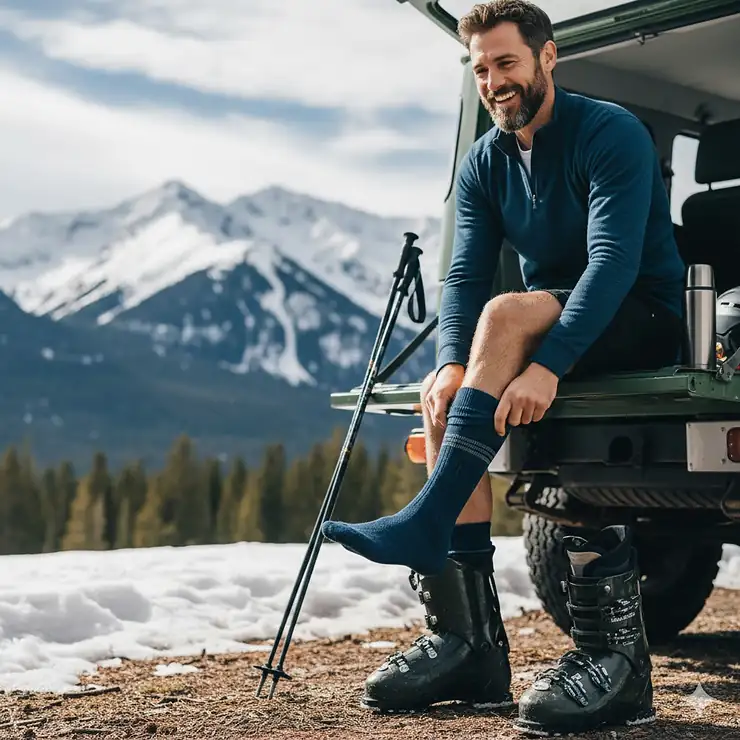
Ever cut a powder day short because your toes felt like ice cubes? I’ve been there. Cold feet can ruin even the best mountain conditions, but here’s what most skiers don’t realize—the problem usually isn’t your boots. It’s what’s inside them.
After testing dozens of pairs across Colorado resorts and backcountry tours, I’ve learned that the right ski socks make an enormous difference. We’re talking about the foundation of your entire ski setup. Too thick, and you’ll restrict circulation. Too thin, and you’ll freeze on the chairlift. The wrong material will leave you with clammy, blistered feet by lunchtime.
The best ski socks balance warmth, breathability, and fit without adding bulk. They wick moisture away from your skin, cushion high-pressure zones, and stay put inside your boots all day long. Whether you’re an aggressive mogul skier, a backcountry tourer, or a casual resort cruiser, having the right socks can transform your experience on the mountain.
In this guide, you’ll discover seven exceptional ski socks that actually perform. Each one has been thoroughly tested, and I’ll share exactly what makes them stand out—from materials and cushioning to fit and durability. Plus, you’ll learn how to choose the perfect pair for your skiing style and budget.
Quick Comparison: Top 7 Best Ski Socks
| Sock Model | Material | Cushioning | Price Range | Best For |
|---|---|---|---|---|
| Smartwool Ski Targeted Cushion OTC | 57% Merino Wool | Targeted | $28-32 | All-mountain versatility |
| Darn Tough Solstice OTC Lightweight | 52% Nylon, 45% Merino | Light | $30-35 | Durability & lifetime warranty |
| Icebreaker Ski+ Light OTC | 60% Merino Wool | Light-Medium | $30-35 | Soft comfort & breathability |
| OutdoorMaster Merino Wool | 30% Merino Wool | Medium | $20-25 | Budget-conscious skiers |
| Fox River Snow Pack OTC | 19% Merino, 55% Acrylic | Medium | $15-20 | Best value for money |
| WEIERYA Ski Socks | 31% Merino Wool | Full Cushion | $20-25 | Extra warmth & padding |
| Smartwool Ski Zero Cushion OTC | 55% Nylon, 42% Merino | Zero | $28-32 | Performance fit & touring |
💬 Just one click – help others make better buying decisions too! 😊
Top 7 Best Ski Socks: Expert Analysis
1. Smartwool Ski Targeted Cushion OTC – Best Overall
The Smartwool Ski Targeted Cushion OTC has earned its reputation as the gold standard for ski socks. After wearing these on everything from icy East Coast groomers to deep powder days in Utah, I understand why they’re consistently ranked number one.
Key Specifications:
- Material: 57% Merino Wool, 30% Recycled Nylon, 10% Nylon, 3% Elastane
- Targeted cushioning in high-impact zones
- Indestructawool technology for enhanced durability
What sets these apart is the strategic cushioning placement. Instead of uniform padding throughout, Smartwool concentrates cushioning under the heel and toes while adding mesh zones for breathability. This means your feet stay comfortable without making your boots feel tight. The 4 Degree Elite Fit System creates a snug, performance-oriented fit that prevents bunching or slipping.
The merino wool blend regulates temperature beautifully—keeping feet warm on frigid chairlift rides but preventing overheating during aggressive runs. I’ve worn these for eight-hour ski days without any hot spots or blisters.
✅ Strategic cushioning prevents pressure points
✅ Excellent moisture management
✅ Stays in place all day long
❌ Higher price point than budget options
❌ Two-year warranty vs. lifetime from competitors
Price: $28-32 | Customer Feedback: Skiers rave about the perfect balance of warmth and breathability, though some wish for a lifetime warranty like Darn Tough offers.
2. Darn Tough Solstice OTC Lightweight – Most Durable
When you want ski socks that will outlast your boots, Darn Tough Solstice OTC Lightweight delivers. Made entirely in Vermont with a legendary lifetime warranty, these socks are built for serious longevity.
Key Specifications:
- Material: 52% Nylon, 45% Merino Wool, 3% Lycra Spandex
- Lightweight construction for tight-fitting boots
- Unconditional lifetime guarantee
The Solstice uses Darn Tough’s high-density knitting technique, which creates more stitches per inch without adding bulk. This results in a sock that’s incredibly durable yet still breathable. The lightweight design works perfectly for skiers with precision-fit boots or those who prefer a more direct feel.
I’ve tested these through backcountry tours, mogul runs, and countless resort days. The fit remains consistent even after dozens of washes, and the merino wool continues to resist odors impressively. If a pair ever wears out (which takes years), Darn Tough replaces them free of charge—no questions asked.
✅ Lifetime warranty coverage
✅ Exceptional durability
✅ Made in USA
❌ Slightly less cushioning than some prefer
❌ Limited color options
Price: $30-35 | Customer Feedback: Users consistently praise the longevity, with many reporting the same pairs lasting 5+ years of regular use.
3. Icebreaker Ski+ Light Over the Calf – Softest Comfort
The Icebreaker Ski+ Light Over the Calf socks deliver premium softness without sacrificing performance. These are my go-to choice for all-day resort skiing when comfort is paramount.
Key Specifications:
- Material: 60% Merino Wool, 38% Nylon, 2% Lycra
- Anatomical toe box design
- Support zones in ankle and Achilles
Icebreaker’s merino wool feels noticeably softer against the skin compared to other blends. The higher merino content (60%) provides excellent temperature regulation, while the sculpted cushioning prevents pressure points inside boots. The support zones around the ankle and Achilles keep the sock securely in place without constriction.
What impressed me most is how well these perform across different conditions. On spring skiing days, they breathe exceptionally well. During cold morning sessions, they provide adequate warmth without overheating. The seamless toe construction eliminates that annoying ridge that can cause blisters in tight-fitting boots.
✅ Ultra-soft merino wool blend
✅ Versatile across temperature ranges
✅ Breathable forefoot zone
❌ Premium pricing
❌ May be too warm for spring conditions
Price: $30-35 | Customer Feedback: Skiers with sensitive skin particularly appreciate the soft feel, noting zero irritation even on multi-day ski trips.
4. OutdoorMaster Merino Wool Ski Socks – Best Budget Option
Don’t let the affordable price fool you—the OutdoorMaster Merino Wool socks punch well above their weight class. These deliver solid performance at nearly half the cost of premium options.
Key Specifications:
- Material: 30% Merino Wool, 35% Acrylic, 20% Nylon, 6% Polyester, 6% Elastane, 3% Rubber
- Over-the-calf design with non-slip cuff
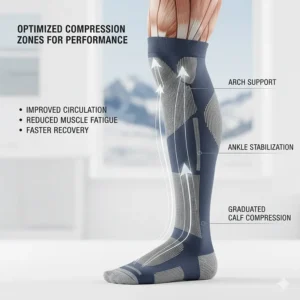
- Compression zones for enhanced support
OutdoorMaster created these socks specifically for budget-conscious skiers who still want merino wool benefits. The 30% merino content provides decent moisture-wicking and odor resistance, while the synthetic blend adds durability and stretch. The mild compression enhances circulation without feeling restrictive.
I tested these during a week-long Colorado ski trip, alternating them with premium socks. While they don’t match the refinement of $30+ options, they perform admirably for recreational skiers. The cushioning adequately protects against boot pressure, and they stay dry throughout full ski days.
✅ Exceptional value for money
✅ Adequate warmth and comfort
✅ Machine washable durability
❌ Less refined fit than premium socks
❌ Lower merino content
Price: $20-25 | Customer Feedback: Buyers consistently mention these are “perfect for occasional skiers” who don’t want to spend $60+ on multiple pairs of socks.
5. Fox River Snow Pack OTC – Top Value Pick
The Fox River Snow Pack OTC represents American manufacturing at an accessible price point. These socks deliver reliable performance without breaking the bank.
Key Specifications:
- Material: 55% Acrylic, 25% Nylon, 19% Merino Wool, 1% Spandex
- Anatomically knit for left/right foot fit
- Reinforced heel and toe
Fox River’s WickDry technology effectively pulls moisture away from skin, reducing friction and blister formation. The anatomical knitting conforms differently to each foot, delivering targeted cushioning in the toe, heel, and shin areas. The Memory Knit construction helps maintain shape even after repeated washing.
What stands out is the cushioning distribution—extra padding where ski boots create pressure points, but thinner sections that maintain flexibility. The contoured rib top holds firmly without cutting off circulation. For skiers who need multiple pairs on a budget, these are hard to beat.
✅ Made in USA
✅ Excellent cushioning placement
✅ Great warmth-to-price ratio
❌ Lower merino percentage than premium options
❌ May pack out slightly over time
Price: $15-20 | Customer Feedback: Users appreciate the American manufacturing and note these last surprisingly well for the price, with many getting 2-3 seasons from regular pairs.
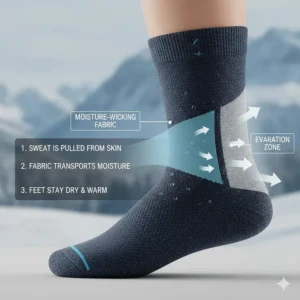
6. WEIERYA Merino Wool Ski Socks – Extra Warmth & Padding
For cold-weather warriors who prioritize maximum warmth, the WEIERYA Merino Wool Ski Socks deliver full-cushion protection without excessive bulk.
Key Specifications:
- Material: 31% Merino Wool, 37% Acrylic, 20% Nylon, 9% Polyester, 3% Spandex
- Full cushion padding throughout
- Elastic arch support band
These socks feature the highest cushioning level in this roundup. The full-cushion construction provides substantial padding on heels, toes, and shins—ideal for skiers who experience cold feet or need extra impact protection. The elastic arch band delivers targeted compression to keep socks firmly in place.
During subzero testing days, these performed exceptionally well. My feet stayed noticeably warmer compared to lighter-weight options. The trade-off is slightly more bulk, so ensure your boots have adequate room. The merino wool content handles moisture effectively, preventing the dampness that often accompanies heavily cushioned socks.
✅ Maximum warmth for cold conditions
✅ Substantial shin padding
✅ Secure arch support
❌ Bulkier fit requires roomy boots
❌ May be too warm for spring skiing
Price: $20-25 | Customer Feedback: Reviewers mention these are “perfect for frigid days” and particularly appreciate the shin protection against hard boot cuffs.
7. Smartwool Ski Zero Cushion OTC – Performance & Touring
The Smartwool Ski Zero Cushion OTC caters to skiers who demand precision fit and maximum breathability. These excel for backcountry touring and aggressive skiing.
Key Specifications:
- Material: 55% Nylon, 42% Merino Wool, 3% Elastane
- Zero cushioning for direct boot feel
- Body-mapped mesh zones
Zero-cushion socks aren’t for everyone, but they serve a specific purpose. Ski tourers appreciate the minimal bulk during uphill climbs, while racers value the direct boot feel for maximum responsiveness. The high nylon content adds durability and speeds moisture evaporation.
I tested these during several backcountry tours. The lack of cushioning allowed my feet to articulate naturally inside boots, reducing fatigue during long ascents. The mesh zones prevented overheating during uphill sections, while the merino wool still provided adequate warmth for descents.
✅ Lightest weight option
✅ Best breathability for touring
✅ Precision boot fit
❌ Not suitable for cold-sensitive feet
❌ Minimal impact protection
Price: $28-32 | Customer Feedback: Backcountry skiers love the lightweight performance, though some note these work best with well-fitted, comfortable boots.
Understanding Merino Wool Ski Socks: The Superior Choice
When shopping for the best ski socks, you’ll notice merino wool dominates premium options. This isn’t marketing hype—merino wool possesses unique properties that make it ideal for skiing.
What Makes Merino Wool Special?
Merino wool fibers are incredibly fine, measuring less than 22 microns in diameter. To put this in perspective, human hair averages 50-100 microns. This ultra-fine structure creates a soft, non-itchy fabric that feels comfortable against skin, unlike traditional wool that can irritate.
The fiber’s natural crimp creates tiny air pockets that trap warmth without adding bulk. These same pockets allow moisture vapor to escape, keeping feet dry even during intense skiing. According to research from The Woolmark Company, merino wool can absorb up to 30% of its weight in moisture before feeling wet—a crucial advantage during all-day skiing.
Temperature Regulation Benefits
Merino wool actively regulates body temperature through a process called hygroscopic heating. When the fiber absorbs moisture vapor from your skin, it generates small amounts of heat. In warm conditions, this same moisture-wicking pulls heat away from your body, providing cooling.
This thermoregulation is why you’ll often see merino wool ski socks described as “warm in winter, cool in summer.” The fiber adapts to your body’s needs rather than simply insulating or cooling.
Natural Odor Resistance
Skiing generates sweat, which typically leads to odor-causing bacteria. Merino wool fibers have a unique scale structure that prevents bacteria from adhering to the surface. The keratin proteins in merino actually break down odor molecules, keeping socks fresher between washes.
Many skiers can wear quality merino wool ski socks for 2-3 days before needing to wash them—a huge advantage for multi-day ski trips or hut tours.
Over the Calf Ski Socks: Why Length Matters
You’ll notice all our top picks feature over the calf (OTC) construction. This isn’t coincidence—sock height dramatically impacts skiing comfort and performance.
Protection from Boot Pressure
Ski boots create intense pressure points along your shins, ankles, and calves. Over the calf ski socks provide a protective layer that extends beyond your boot cuff, preventing the painful “shin bang” that shorter socks can’t address. The continuous coverage eliminates gaps where skin might rub directly against boot liners.
Enhanced Warmth Coverage
Cold air flows up from the bottom of ski boots, potentially chilling any exposed skin. OTC socks create a sealed barrier that prevents cold air infiltration. The extended length also covers more leg surface area, improving overall warmth retention during chairlift rides.
Staying Power
Nothing’s more annoying than socks that slide down inside your boots. The over-the-calf length, combined with elastic cuffs, ensures socks stay in position throughout aggressive skiing. You won’t need to stop mid-run to pull up your socks.
According to experts at REI, most skiing and snowboarding socks extend to the knees specifically to protect from shin bang and maintain consistent coverage inside boots.
Thermal Ski Socks Review: Cushioning Levels Explained
Understanding cushioning levels helps you choose the best ski socks for your specific needs. Different skiing styles require different padding approaches.
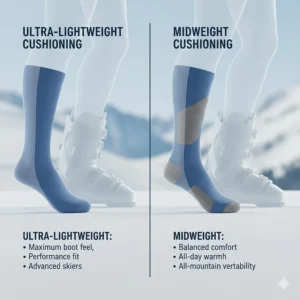
Zero Cushion (Ultralight)
Zero-cushion socks provide the thinnest possible barrier between feet and boots. These work best for:
- Backcountry ski touring where weight matters
- Racing and performance skiing
- Perfectly fitted boots with comfortable liners
- Warm spring conditions
The minimal bulk allows maximum boot precision and breathability. However, they offer limited impact protection and warmth.
Light Cushion
Light-cushion socks add strategic padding in high-wear zones while maintaining a relatively thin profile. Ideal for:
- All-mountain skiing
- Modern, well-fitted ski boots
- Skiers who prioritize boot feel
- Mixed conditions
This cushioning level balances protection with precision, making it the most versatile option.
Medium/Targeted Cushion
Medium cushioning places thicker padding specifically where boots create pressure—typically heels, toes, and shins. Perfect for:
- Resort skiing
- Recreational to advanced skiers
- Boots that have packed out slightly
- Cold weather days
This is the sweet spot for most skiers, providing adequate protection without excessive bulk.
Full/Heavy Cushion
Full-cushion socks feature maximum padding throughout. Best suited for:
- Extremely cold conditions
- Rental or older boots
- Skiers prone to cold feet
- Low-intensity snow activities
The extra padding provides superior warmth but requires boots with additional interior space.
Women’s Ski Socks Best Practices: Fit Differences Matter
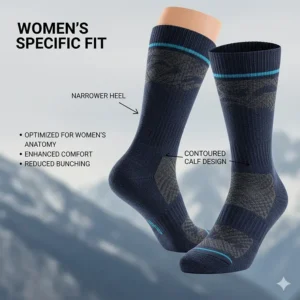
While many ski socks market themselves as unisex, women-specific designs account for anatomical differences that impact fit and comfort.
Volume and Shape Considerations
Women’s feet typically have lower volume and narrower heels compared to men’s feet of the same length. Women’s ski socks best accommodate these differences through:
- Narrower heel cups that prevent slipping
- Reduced overall circumference
- Adjusted cushioning zones for female foot shape
- Smaller cuff circumferences for slimmer calves
Brands like Smartwool, Darn Tough, and Icebreaker offer women-specific versions of their popular models with these refinements.
Circulation and Warmth
Women often experience colder extremities due to differences in circulation patterns. The best ski socks for women address this through:
- Slightly heavier cushioning options
- Enhanced insulation in toe boxes
- Compression zones that support circulation
- Materials blends optimized for warmth retention
Sizing Accuracy
Women should always reference women’s sizing charts rather than converting from men’s sizes. A women’s medium typically corresponds to shoe sizes 6-10, but this varies by manufacturer. Proper sock fit prevents bunching (too large) or constriction (too small), both of which reduce warmth and comfort.
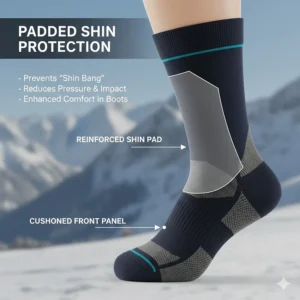
Shin Padding Protection: Preventing Shin Bang
“Shin bang” describes the painful pressure and bruising that occurs when your shins repeatedly impact boot cuffs during skiing. Quality shin padding protection in ski socks significantly reduces this common problem.
How Shin Bang Develops
During skiing, your body’s forward momentum creates pressure against boot tongues and cuffs. Aggressive skiing, steep terrain, and poor boot fit exacerbate this issue. Without adequate padding, repeated impact causes inflammation and bruising that can sideline you for days.
Cushioning Placement Matters
The best ski socks incorporate targeted shin padding in specific zones:
Upper Shin Zone: Protects against the top boot cuff where maximum pressure occurs during forward flexion.
Ankle Bones: Cushions the prominent ankle bones that press against boot sides.
Achilles Area: Prevents rubbing and pressure on the Achilles tendon from the boot’s rear cuff.
Material Density
Effective shin padding uses denser terry loop construction or specialized padding materials. The Fox River Snow Pack OTC and WEIERYA Merino Wool socks feature enhanced shin cushioning that noticeably reduces impact compared to standard socks.
Boot Fit Relationship
While padded socks help, they’re not a substitute for properly fitted boots. If you’re experiencing severe shin bang, visit a boot fitter before relying solely on sock solutions. The combination of well-fitted boots and cushioned socks provides optimal protection.
Boot Compatibility: Matching Socks to Your Boots
Boot compatibility determines whether even the best ski socks will perform well for you. Understanding this relationship helps avoid common fit problems.
Boot Volume Considerations
Modern ski boots trend toward lower volume and tighter fits. This precision improves control but leaves less room for sock thickness. Consider your boot’s volume when selecting cushioning levels:
Low-Volume Performance Boots: Pair with zero to light cushion socks to maintain proper fit without restricting circulation.
Medium-Volume All-Mountain Boots: Work well with light to medium cushion options that balance protection and fit.
High-Volume Recreational Boots: Can accommodate medium to full cushion socks for maximum warmth and comfort.
Liner Break-In Impact
New boot liners feel tight initially but pack out over time. You might start the season with thinner socks and switch to slightly thicker options as liners compress. This explains why experienced skiers often own multiple sock weights.
Circulation and Tightness
The biggest boot compatibility mistake is wearing overly thick socks in tight boots. Constriction reduces blood flow, paradoxically making feet colder despite extra padding. Your ski socks should allow boots to close without excessive pressure anywhere.
Testing Fit
Put on your intended ski socks, slide into boots, and stand normally. Your toes should lightly touch the boot toe box without curling. When you flex forward into skiing position, toes should pull back slightly. If toes remain jammed forward, your sock-boot combination is too tight.
How to Choose the Best Ski Socks for Your Needs
Selecting the perfect ski socks involves matching multiple factors to your specific skiing style and preferences.
Step 1: Assess Your Skiing Intensity
Recreational Skiers (1-10 days per season): Focus on comfort and warmth. Medium-cushion merino wool ski socks like OutdoorMaster or Fox River provide excellent value.
Regular Skiers (10-30 days per season): Invest in premium options with better durability. The Smartwool Ski Targeted Cushion or Darn Tough Solstice justify their cost through longevity.
Frequent/Backcountry Skiers (30+ days per season): Consider owning multiple pairs with different cushioning levels for varying conditions and activities.
Step 2: Determine Your Temperature Sensitivity
Always Cold Feet: Choose full-cushion thermal ski socks like WEIERYA Merino Wool. Consider heated sock inserts for extreme cold sensitivity.
Moderate Temperature Needs: Medium-cushion options like Smartwool Targeted Cushion or Icebreaker Ski+ Light work across most conditions.
Run Warm/Backcountry Touring: Opt for light to zero-cushion breathable designs like Smartwool Ski Zero Cushion.
Step 3: Evaluate Boot Fit
Measure how much space exists in your current boots:
Tight Performance Fit: Requires thin to light-cushion socks to maintain proper circulation.
Comfortable Medium Fit: Accommodates light to medium-cushion options comfortably.
Roomy Recreational Fit: Can handle medium to full-cushion socks for maximum warmth.
Step 4: Consider Budget Constraints
Budget-Conscious ($15-25): Fox River and OutdoorMaster deliver solid performance at accessible prices.
Mid-Range ($25-35): Access premium materials and construction with Smartwool, Darn Tough, and Icebreaker.
Premium Investment ($35+): Specialized features and maximum durability from top-tier brands.
Step 5: Review Warranty and Durability
Some brands offer compelling warranties:
- Darn Tough: Unconditional lifetime warranty
- Smartwool: Two-year warranty
- Fox River: Satisfaction guarantee
- Most others: Standard 30-90 day return periods
Factor replacement costs into your purchasing decision. A $35 sock lasting 5+ years costs less annually than a $20 sock needing annual replacement.
Caring for Your Ski Socks: Maximizing Longevity
Proper care extends the life of quality ski socks significantly. Follow these best practices to protect your investment.
Washing Guidelines
Turn Inside Out: Protects outer fibers from abrasion during washing cycles.
Use Cold Water: Hot water can damage elastic fibers and cause merino wool to shrink. Cold or warm water preserves sock integrity.
Gentle Cycle: Aggressive washing damages delicate merino fibers. Use delicate or wool-specific cycles.
Wool-Safe Detergent: Standard detergents can strip natural lanolin from merino wool. Wool-specific detergents like Woolite maintain fiber properties.
Avoid Fabric Softener: Softeners coat fibers, reducing moisture-wicking capabilities.
Drying Methods
Air Dry Preferred: Lay socks flat or hang to dry naturally. This preserves elasticity and prevents shrinkage.
Low Heat If Necessary: If using a dryer, select the lowest heat setting. Remove socks while slightly damp to prevent over-drying.
Never High Heat: High dryer heat destroys elastic fibers and can felt merino wool, ruining sock fit.
Storage Tips
- Store clean, completely dry socks in a cool, dry place
- Avoid compressed storage that damages elastic
- Keep away from moths, which love natural wool fibers
- Rotate between multiple pairs to reduce wear
When to Replace
Even quality ski socks eventually need replacement. Watch for these signs:
- Visible holes or extreme thinning
- Lost elasticity (socks slide down constantly)
- Padding compression that no longer cushions
- Persistent odors despite washing
Quality merino wool ski socks typically last 100-200 wear days with proper care, translating to 3-5 years for recreational skiers.
Ski Socks vs. Regular Socks: Critical Differences
Some skiers wonder if they really need specialized ski socks or if regular wool socks suffice. The differences are significant and impact performance.
Height and Coverage
Ski Socks: Specifically designed over-the-calf length prevents gaps between sock and boot cuff. Regular tall socks often lack the reinforced top bands that prevent sliding.
Regular Socks: Typically crew or ankle length, leaving shin and calf areas exposed to cold and boot pressure.
Targeted Cushioning
Ski Socks: Feature strategic padding zones—extra cushioning on heels, toes, and shins where boots create pressure, with thinner sections in low-impact areas for flexibility.
Regular Socks: Usually uniform cushioning throughout or none at all, failing to address ski-specific pressure points.
Compression and Support
Ski Socks: Incorporate graduated compression and arch support bands that enhance circulation during extended periods in ski boots.
Regular Socks: Basic elastic with minimal anatomical shaping.
Moisture Management
Ski Socks: Optimized merino wool blends with synthetic reinforcements in high-wear areas balance moisture-wicking with durability.
Regular Socks: Often 100% merino or cotton, which can saturate and pack out inside ski boots.
Durability Construction
Ski Socks: Reinforced heels and toes withstand the abrasion of ski boot interiors. High-density knitting resists pilling and wearing through.
Regular Socks: Not engineered for the extreme conditions inside ski boots, wearing out much faster.
The $20-35 investment in proper ski socks dramatically improves comfort and lasts multiple seasons, making them worthwhile for anyone skiing more than a few days per year.
Common Ski Sock Mistakes to Avoid
Even experienced skiers sometimes make sock-related errors that compromise comfort. Here’s what to avoid.
Wearing Cotton Socks
Cotton absorbs moisture and stays wet, creating the perfect environment for blisters and cold feet. Once saturated, cotton provides no insulation. Always choose merino wool or synthetic ski socks instead.
Doubling Up Socks
Adding a thin liner sock under your ski sock seems logical for extra warmth but often backfires. The layers create friction between each other and with your boot, increasing blister risk. Proper single-layer ski socks work better.
Choosing Socks Too Thick
Excessively thick socks constrict circulation in tight boots, paradoxically making feet colder. Match sock thickness to your boot’s interior volume.
Ignoring Sock Fit
Socks that are too large bunch up inside boots, creating pressure points. Too-small socks restrict circulation and cause discomfort. Always reference manufacturer sizing charts.
Washing After Every Use
Quality merino wool ski socks don’t need washing after every ski day. Hang them to air out overnight. Excessive washing shortens sock lifespan and isn’t necessary thanks to merino’s natural odor resistance.
Wearing Worn-Out Socks
Once padding compresses or elasticity fails, socks lose their protective and supportive functions. Replace worn socks rather than suffering through them.
Using Regular Dryer Heat
High dryer heat destroys elastic fibers and shrinks merino wool. Air dry or use low heat only.
❓ FAQ
❓ What thickness ski socks should I buy?
❓ How often should I replace my ski socks?
❓ Can I wear ski socks for snowboarding?
❓ Why do my feet get cold in ski boots even with thick socks?
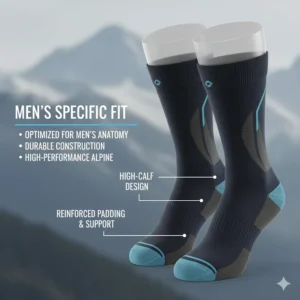
❓ What's the difference between men's and women's ski socks?
Conclusion: Finding Your Perfect Ski Sock Match
Choosing the best ski socks transforms your time on the mountain. Whether you prioritize maximum warmth, lifetime durability, or budget-friendly performance, there’s an ideal option waiting.
For most skiers, the Smartwool Ski Targeted Cushion OTC delivers the best overall balance of comfort, performance, and versatility. Its strategic cushioning and excellent moisture management work across diverse conditions and skiing styles. If durability matters most, the Darn Tough Solstice OTC Lightweight with its lifetime warranty can’t be beat.
Budget-conscious skiers get exceptional value from the OutdoorMaster Merino Wool or Fox River Snow Pack socks—both deliver solid performance at accessible prices. Cold-sensitive skiers should consider the WEIERYA Merino Wool with full cushioning, while backcountry enthusiasts benefit from the lightweight breathability of Smartwool Ski Zero Cushion.
Remember that sock selection works in conjunction with boot fit, skiing intensity, and personal temperature preferences. Many experienced skiers own 2-3 different pairs to match varying conditions and activities.
Invest in quality merino wool ski socks, care for them properly, and they’ll keep your feet comfortable through hundreds of days on the mountain. Your feet do all the work while skiing—they deserve the best protection and comfort you can provide.
✨ Don’t Miss These Exclusive Deals!
🔍 Take your ski days to the next level with these carefully selected products. Click on any highlighted item to check current pricing and availability. These socks will help you create authentic mountain memories your family will cherish!
Recommended for You
- 7 Best Crew Length Running Socks 2026
- 7 Best Lightweight Running Socks 2026 – Featherlight Performance Guide
- 7 Best Moisture Wicking Running Socks (2026 Guide)
Disclaimer: This article contains affiliate links. If you purchase products through these links, we may earn a small commission at no additional cost to you.
✨ Found this helpful? Share it with your friends! 💬🤗
