
In This Article
Picture this: you board a 10-hour flight feeling completely fine. You land, shuffle off the plane, and your ankles look like they belong to a different, much puffier person. Your calves ache. Your feet feel like they’ve been wrapped in wet cement. Sound familiar?

That swelling isn’t just uncomfortable vanity — it’s your circulatory system working against physics. At cruising altitude, cabin pressure drops and cabin humidity falls to around 10–15%, while your legs hang stationary for hours with gravity doing the blood-pooling work it was born to do. The result: fluid accumulates, circulation slows, and for some people, the risk of deep vein thrombosis (DVT) quietly climbs.
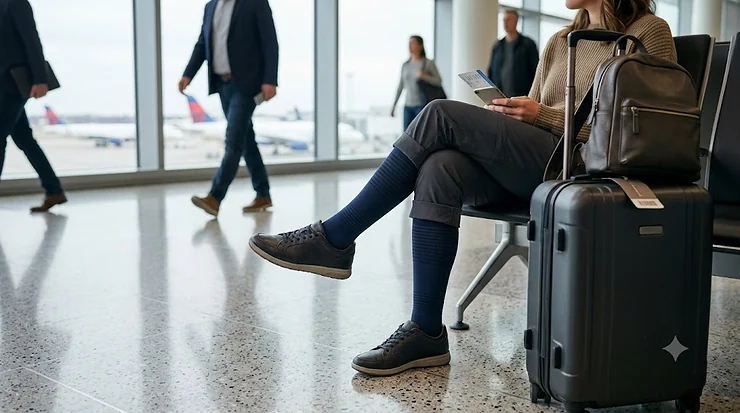
This is exactly where 15-20 mmhg compression socks for travel earn their keep. Not the stiff, beige medical stockings your grandmother wore — we’re talking modern, well-engineered, actually-wearable gear that fits under your jeans and disappears into your travel kit without a second thought.
The “15-20 mmhg” part matters more than you’d think. This compression level — classified as moderate, or Class 1 — sits in the sweet spot for travelers. It’s firm enough to meaningfully push blood back toward the heart, keeping that graduated-pressure pumping effect working in your favor. But it’s not so tight that you’re wrestling with the socks for ten minutes in an airport bathroom at 5 AM or spending your flight feeling like your legs are being squeezed in a vice. If you’ve tried 20-30 mmhg socks and found them brutal to put on, 15-20 mmhg will feel like a revelation.
Research published through the Cochrane Library — the gold standard of evidence-based medicine — analyzed 12 trials involving nearly 3,000 airline passengers. The findings are convincing: wearing compression stockings substantially reduces the risk of symptomless DVT during flights, dropping incidence from tens per thousand passengers down to just two or three. The American Academy of Family Physicians (AAFP) echoes this, noting stockings are effective for flights longer than five hours in both high-risk and low-risk travelers.
In this guide, I’ve tested and researched the seven best 15-20 mmhg compression socks for travel currently available on Amazon — covering every budget, body type, and travel style. Let’s get into it.
Quick Comparison: 7 Best 15-20 mmhg Travel Compression Socks at a Glance
| Product | Material | Best For | Price Range | Rating |
|---|---|---|---|---|
| CHARMKING Graduated Compression Socks (3 Pairs) | Nylon/Spandex | Budget travelers, daily use | $10–$18 | ⭐ 4.5/5 |
| Iambamboo Merino Wool Compression Socks (2 Pack) | Merino Wool/Bamboo Viscose | Long-haul flyers, sensitive skin | $28–$38 | ⭐ 4.6/5 |
| Sockwell In Flight Moderate Graduated Compression | Merino Wool/Bamboo Rayon | Comfort-first travelers | $28–$38 | ⭐ 4.5/5 |
| SIGVARIS Merino Wool 192 Knee-High Compression | 53% Merino Wool/38% Nylon | Medical-grade quality seekers | $45–$65 | ⭐ 4.7/5 |
| JOBST Travel Compression Socks 15-20 mmhg | Nylon blend | DVT-prevention focused travelers | $20–$32 | ⭐ 4.4/5 |
| VIM & VIGR 15-20 mmhg Nylon Compression Socks | Nylon/Spandex | Nurses, frequent flyers | $25–$35 | ⭐ 4.5/5 |
| Bluemaple 6-Pack Compression Socks | Nylon/Spandex | Value buyers, multi-pair households | $18–$28 | ⭐ 4.4/5 |
Table Analysis: The breakdown reveals clear segmentation. SIGVARIS and Iambamboo command a premium price for medical-grade construction and natural fiber performance — worth it for frequent travelers with circulation concerns. CHARMKING and Bluemaple deliver solid everyday value for the cost of a single airport lunch. The mid-tier (JOBST, VIM & VIGR, Sockwell) hits the sweet spot most travelers should target: proven brand reputation, comfortable wear time, and reasonable durability over multiple washes.
💬 Just one click — help others make better buying decisions too! 😊
Top 7 Travel Compression Socks 15-20 mmhg: Expert Analysis
1. CHARMKING Graduated Compression Socks (3 Pairs) — 15-20 mmhg
If the compression sock world had a people’s champion, CHARMKING would be it. This three-pack is one of the most popular 15-20 mmhg options on Amazon — and for good reason. The nylon/spandex blend delivers genuine graduated compression that starts firm at the ankle and eases up toward the knee, which is exactly how therapeutic compression is supposed to work.
Key specs and what they actually mean: The nylon-dominant construction wicks moisture effectively — important on a long-haul flight where cabin humidity hovers around 10%. The reinforced toe and heel mean these won’t develop the dreaded “thin spot” after a few washes, which cheaper socks absolutely do. Available in S/M (US Women 5.5–8.5 / US Men 5–9) and L/XL, with dozens of color options so you don’t have to look like you raided a medical supply closet.
Who these are for: CHARMKING is the perfect entry-level travel compression sock. If you’ve never worn compression socks before and want to try the concept without spending $50, this is your starting point. They’re also great as a “backup pair” to toss in your carry-on alongside a premium set.
Customer feedback: Buyers consistently describe them as “easier to put on than other compression socks” and note the compression feels supportive without being overly tight — ideal for first-timers who worry about the claustrophobic tightness sometimes associated with compression gear. One honest note from reviews: the colors on novelty-pattern versions occasionally differ slightly from photos.
✅ Great value for the 3-pair price
✅ Easy to put on and take off
✅ Wide color selection for style-conscious travelers
❌ Not ideal for serious medical-grade DVT prevention (no FDA listing)
❌ Color accuracy on patterned versions can be inconsistent
Price range: In the $10–$18 range for a 3-pack — exceptional cost-per-sock value.
2. Iambamboo Merino Wool Compression Socks for Women Men, 15-20 mmhg Knee High — 2 Pack
Merino wool in a compression sock is the equivalent of flying business class versus economy. It costs more. It’s noticeably better. And once you’ve tried it, going back feels like a downgrade. Iambamboo’s 15-20 mmhg merino wool travel socks combine a merino wool/bamboo viscose blend with a 4-zone graduated compression design that targets the arch, ankle, calf, and upper leg independently.
Key specs and what they actually mean: The merino-bamboo blend does three things synthetics can’t match: it actively thermoregulates (warm in the AC-blasted cabin, cool when you’re rushing through a connecting terminal), it’s naturally anti-microbial (no sock smell on day two of a long trip), and it’s genuinely soft against skin. The 4-zone graduated compression isn’t just marketing — it means the pressure truly moves from strongest at the ankle to gentlest at the top of the calf, mimicking the pumping action of leg muscles during walking.
Who these are for: Frequent flyers, anyone on 8+ hour flights, travelers who run hot or cold, and people with sensitive skin who’ve found other compression socks itchy or irritating. These are particularly good for travelers who keep their socks on through the flight AND walk around the destination city afterward.
Customer feedback: Users praise the all-day wearability and note they don’t have to peel them off the moment they deplane. The unisex sizing works well for both men and women.
✅ Merino wool thermoregulation — ideal for long flights
✅ Naturally odor-resistant for multi-day wear
✅ Seamless toe closure prevents blister hotspots
❌ Higher price point than synthetic options
❌ Merino requires more careful washing than nylon blends
Price range: Around $28–$38 for a 2-pack.
3. Sockwell In Flight Moderate Graduated Compression Socks — 15-20 mmhg
Sockwell has built one of the most loyal followings in the compression sock world, and the In Flight model is the one that started it. Made in the USA with an eco-friendly merino wool, bamboo rayon, stretch nylon, and spandex blend (32%/31%/32%/5%), these socks hit a very specific traveler profile: someone who cares about quality, sustainability, and not looking like they’re wearing medical equipment.
Key specs and what they actually mean: The merino/bamboo rayon combination creates a fabric that’s genuinely different from standard nylon compression socks. Bamboo rayon is one of the most breathable fibers available — it pulls moisture away from skin faster than standard nylon, which matters when you’re sealed in a dry pressurized tube for 12 hours. The airplane-pattern design isn’t just cute; it’s a conversation starter that screams “seasoned traveler” rather than “leg problems.”
Who these are for: Style-conscious travelers who don’t want compression socks that look clinical. Also excellent for people with shorter legs who sometimes find other brands bunching behind the knee — Sockwell’s fit tends to run truer for various leg lengths. The moderate 15-20 mmhg feels slightly firmer than some other moderate brands, which some travelers prefer.
Customer feedback: Reviews note these feel tighter than expected for 15-20 mmhg, which is actually a compliment — it means the compression is genuine and consistent, not inflated on the label. Shorter-legged users appreciate the fit more than taller counterparts.
✅ Made in the USA with eco-friendly materials
✅ Bamboo rayon delivers exceptional breathability
✅ Fun designs that don’t look clinical
❌ May feel too firm for first-time compression sock wearers
❌ Hand-wash recommended for longevity (inconvenient for frequent travelers)
Price range: In the $28–$38 range per pair.
4. SIGVARIS Men’s/Women’s Merino Wool 192 Knee-High Compression Socks — 15-20 mmhg
SIGVARIS is the name vascular surgeons mention when they tell patients to “get proper compression socks.” Founded in 1864 in Switzerland, this brand has been making medically validated compression legwear for longer than most compression sock brands have existed. The Merino Wool 192 line brings that clinical pedigree into a genuinely wearable everyday form.
Key specs and what they actually mean: The 53% extra-fine merino wool, 38% nylon, 9% spandex composition isn’t just comfortable — it’s engineered. SIGVARIS products are manufactured to maintain consistent, accurate compression throughout the garment’s lifespan, something cheaper brands genuinely cannot guarantee. The “extra-fine” merino designation matters: this is the soft, itch-free grade used in high-end knitwear, not the coarser agricultural wool that causes irritation. FDA-registered and developed in partnership with vascular specialists, these deliver compression you can actually trust is calibrated correctly.
Who these are for: Travelers with existing vein issues, varicose veins, a family history of DVT, post-surgical recovery, or anyone who wants the closest thing to a clinical product without needing a prescription. Also ideal for travelers who can’t afford to gamble on whether the compression is actually at 15-20 mmhg — with SIGVARIS, it is.
Customer feedback: Users with chronic venous conditions report consistent relief that cheaper brands don’t match. Common praise: “my legs don’t hurt anymore after flights” from people who’ve tried multiple brands without success.
✅ SIGVARIS’ medical-grade manufacturing precision
✅ Thermoregulating, itch-free extra-fine merino wool
✅ Designed with vascular surgeons — real therapeutic credibility
❌ Premium price point (highest on this list)
❌ Sizing runs specific to measurements — check the SIGVARIS size chart carefully
Price range: In the $45–$65 range per pair.
5. JOBST Travel Compression Socks — 15-20 mmhg Knee High
JOBST has been making compression hosiery since 1950 — before “compression socks” was even a consumer category. The Travel line was specifically designed for the airplane-passenger use case, and it shows. These are not repurposed athletic or medical socks with “travel” slapped on the label; the design accounts for the unique physiological demands of long-haul inactivity.
Key specs and what they actually mean: The graduated 15-20 mmhg compression is calibrated to the “Economy Class Syndrome” risk profile — prolonged sitting, restricted movement, dehydration, and altitude-related cabin pressure changes. JOBST notes explicitly that DVT risk is reduced with their travel socks, a claim backed by NIHR research showing compression stockings can drop DVT risk from 10 in 1,000 to 1 in 1,000 in healthy travelers. The closed-toe, unisex design fits neatly under business or casual travel attire.
Who these are for: Business travelers who want a no-nonsense, medically credible product with a legacy track record. Also smart for anyone over 50, pregnant travelers (with doctor approval), or anyone who’s ever had a DVT scare and wants proven-brand peace of mind.
Customer feedback: Long-time users of JOBST medical products note the travel socks feel less constrictive than the medical lines while still delivering effective support. Common comment: “I’ve worn these on every transatlantic flight for three years.”
✅ 70+ year track record in compression therapy
✅ Explicitly designed for airplane travel conditions
✅ Unisex design fits cleanly under any travel attire
❌ Fewer style/color options than lifestyle brands
❌ Can feel clinically utilitarian compared to merino alternatives
Price range: Around $20–$32 per pair.
6. VIM & VIGR 15-20 mmhg Nylon Compression Socks for Women & Men
VIM & VIGR is a Montana-based small business that developed their compression legwear range in direct collaboration with vascular surgeons and vein clinics — a founding story that gives them instant credibility above the typical drop-shipped sock brand. All products are FDA-listed. The 15-20 mmhg nylon line is their most popular travel option, blending clinical backing with an impressive range of style options that have made them a favorite among nurses and frequent flyers alike.
Key specs and what they actually mean: The 91% nylon / 9% spandex construction is a deliberate choice. Nylon-dominant socks are more durable through repeated washing than spandex-heavy alternatives, and maintain their compression integrity longer — crucial if you’re washing these every other flight. The machine-wash-after-each-wear recommendation (cold, delicate cycle) means these integrate into a real travel routine rather than requiring the careful hand-washing of merino options.
Who these are for: Nurses who travel, frequent flyers doing 50+ flights a year who go through socks quickly, and anyone who wants a slightly more “insider” brand that other travelers will notice. Also excellent for people with wider calves — VIM & VIGR’s wide-calf options maintain proper gradient pressure without the tourniquet effect you sometimes get from poorly designed wide-calf versions.
Customer feedback: The ER nurse community has essentially adopted VIM & VIGR as a standard — high praise from people who wear compression socks for 12-hour shifts. One consistent note: shorter-legged users find the fit excellent, while taller buyers should measure carefully before ordering.
✅ FDA-listed, developed with vascular surgeons
✅ Durable nylon construction — holds compression through many washes
✅ Excellent wide-calf option without losing compression quality
❌ Nylon doesn’t thermoregulate like merino wool
❌ Fit works better for shorter leg lengths
Price range: In the $25–$35 range per pair.
7. Bluemaple 6-Pack Compression Socks — 15-20 mmhg for Travel
If you’re the type of traveler who needs multiple pairs readily available — think: frequent flyers who pack for weeks at a time, families prepping multiple people for a long trip, or budget travelers stocking up before a big journey — Bluemaple’s 6-pack proposition is genuinely hard to beat. These copper-infused nylon socks deliver competent 15-20 mmhg graduated compression with a fun array of designs that lean more toward “lifestyle sock” than “medical supply.”
Key specs and what they actually mean: The copper-infused fabric is the headline feature. Copper’s anti-microbial properties reduce odor-causing bacteria — genuinely useful for multi-day travel when laundry access is limited. The graduated compression runs from ankle to below-knee in the standard arch-to-calf gradient. The 6-pair pack delivers cost-per-pair value that makes disposable-level pricing per sock possible at trip’s end if needed.
Who these are for: Budget-conscious travelers, families buying for multiple members, frequent travelers who go through socks quickly, and anyone who wants a solid workhorse sock without premium material expectations. Also a great “try compression socks for the first time” option at low commitment.
Customer feedback: Buyers appreciate the fun embroidered designs (animal and geometric patterns are popular) and note the compression feels effective for daily travel and long shifts. The fit is accurate to the S/M sizing range, and elasticity holds well through multiple machine washes.
✅ 6-pair value makes cost-per-sock very low
✅ Copper-infused fabric for odor resistance
✅ Fun designs — looks more like fashion socks than medical gear
❌ Compression less precise than medical-brand alternatives
❌ Wide-calf option runs slightly loose for slender legs
Price range: Around $18–$28 for the 6-pack.
✨ Don’t Miss These Exclusive Deals!
🔍 Ready to protect your legs on your next flight? Click on any highlighted product above to check current pricing and availability on Amazon. Your future self — the one walking off the plane without cankles — will thank you.
How to Actually Put On and Get the Most From Your Travel Compression Socks: A Practical Guide
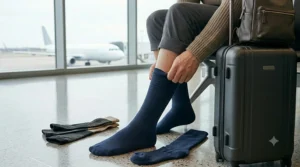
Here’s a secret most product pages won’t tell you: how you put on compression socks matters almost as much as which ones you buy. Get this wrong and you’ll have bunched-up fabric behind your knee, uneven pressure, and all the discomfort of compression with none of the benefit.
Step 1 — Put them on before you swell, not after. The morning of travel is ideal. If you wait until you’re already sitting in your seat, your ankle circumference may already be 5–10mm larger than your baseline, making the socks harder to put on and fitting less accurately.
Step 2 — The inside-out method. Turn the sock inside out down to the heel. Slip your foot in, position the heel cup carefully (misaligned heels are the number-one comfort complaint), then roll the sock up your leg in sections rather than pulling straight up. This distributes the compression fabric evenly.
Step 3 — Check the fit. No bunching behind the knee — this creates a tourniquet effect that reverses the compression benefit. The top band should sit firmly but not cut into your skin. The toe seam (if present) should fall cleanly at the toe base.
Step 4 — Keep them on through the flight AND during the first 30 minutes after landing. The swelling risk doesn’t evaporate the moment you land. Blood pooling continues while you wait for luggage, ride to the hotel, or navigate arrivals. Keep them on until you’re genuinely active.
Step 5 — Move around. Compression socks dramatically reduce swelling and DVT risk, but they work best alongside movement. Every 60–90 minutes, get up for a walk or do ankle rotations in your seat — this activates your calf muscles, which are essentially the secondary pump for venous return.
Washing tip: Machine wash cold on delicate after each wear. Air dry rather than tumble dry — heat breaks down elasticity in the compression fibers, which is why your $50 SIGVARIS pair doesn’t maintain its calibrated 15-20 mmhg after 50 hot-dryer cycles.
Who Actually Needs 15-20 mmhg Compression Socks for Travel? A Real-World Scenario Guide
Not all travelers come to compression socks from the same place. Here are the three most common traveler profiles — and which product from this list suits each one best.
The Occasional Holiday Flyer
You take two or three long-haul flights a year, maybe a European trip and a domestic connection. Your legs feel fine on short flights but definitely swell on anything over six hours. You’ve never worn compression socks before and you’re not sure if you need “proper” medical ones.
Best fit: CHARMKING 3-pack (budget entry), or Iambamboo Merino Wool for a one-time investment in something genuinely comfortable. The CHARMKING gives you three pairs to test the concept without financial commitment; the Iambamboo rewards you with comfort so good you’ll actually want to wear them.
The Frequent Business Traveler
You’re on planes 30+ times a year. Your legs know the drill — dull aching, ankle swelling, that heavy feeling that doesn’t resolve until day two at the destination. You’ve tried generic compression socks and found them itchy, uncomfortable, or falling down mid-flight.
Best fit: VIM & VIGR 15-20 mmhg (durable, washable, FDA-listed) or Sockwell In Flight (if you want the merino upgrade). At this volume of flying, the long-term durability of VIM & VIGR’s nylon construction makes more economic sense than constantly replacing cheaper pairs.
The High-Risk Traveler
You’re over 60, pregnant (with your doctor’s blessing), have a history of varicose veins or previous DVT, or you’re flying immediately after surgery. You need compression you can trust — not fashion socks with “compression” in the name.
Best fit: SIGVARIS Merino Wool 192, no question. The medical-grade manufacturing, vascular surgeon involvement, and 160+ years of brand credibility are worth the premium price when the stakes are your circulatory health. Pair with JOBST Travel socks as your second pair for long trips.
How to Choose 15-20 mmhg Compression Socks for Travel: 6 Criteria That Actually Matter
The market is flooded with options. Here’s what separates socks that work from ones that just claim to.
1. Verify the compression claim. The 15-20 mmhg number should be verifiable. Look for FDA-registered or FDA-listed brands (SIGVARIS, VIM & VIGR, JOBST), which must demonstrate their products actually deliver stated compression levels. Unregistered brands self-report — which sometimes means the “15-20 mmhg” is more aspirational than accurate.
2. Match material to your travel style. Merino wool (Iambamboo, Sockwell, SIGVARIS) excels on long hauls and multi-day trips — thermoregulating, odor-resistant, naturally soft. Nylon blends (CHARMKING, VIM & VIGR, Bluemaple, JOBST) are tougher, easier to wash, and better for frequent travelers who need durability. Neither is universally better; it depends on your use case.
3. Size by calf measurement, not shoe size. This is the most common mistake in the entire compression sock market. A sock labeled “M” based on shoe size can fit calves ranging from 12–18 inches — that’s a massive variation that dramatically affects actual compression pressure. Measure your calf circumference at the widest point and match to the brand’s specific size chart. Every brand differs.
4. Consider ease of donning. If you’re traveling solo with stiff joints, a heavy carry-on, and 4 AM departure energy levels, a sock that requires significant effort to put on will eventually get left in your bag. 15-20 mmhg is generally easier to don than 20-30 mmhg, but within the 15-20 mmhg category, merino blends tend to be slightly more forgiving than pure nylon during application.
5. Check the top band construction. A silicone-free, non-binding top band is ideal for travel. Too tight and it creates a ridge — uncomfortable on a long flight and counterproductive to circulation. Too loose and the sock slides down, eliminating the compression gradient entirely.
6. Think about total cost of ownership. A $12 three-pack that loses compression after 10 washes costs more per quality compression session than a $50 SIGVARIS pair that maintains calibrated pressure for 200+ washes. Do the math before defaulting to budget options, especially if you’ll be wearing these regularly.
The Real Science of 15-20 mmhg: What “Economy Class Syndrome” Actually Is
“Economy Class Syndrome” became a household phrase in the early 2000s, when a string of DVT-related deaths in long-haul passengers prompted international attention. The Wikipedia entry on deep vein thrombosis describes it clearly: immobility causes venous stasis — blood literally slows down and pools in the deep veins of the legs. Add dehydration (cabin air is notoriously dry), reduced cabin pressure, and the cramped angle of your legs in an economy seat, and you have a textbook environment for clot formation.
The good news: you don’t have to be high-risk for compression socks to help. The Cochrane review of 12 trials (2,918 participants) found that wearing below-knee compression stockings resulted in a “large reduction in symptomless DVT” — dropping risk from tens per thousand passengers to just two or three. Among high-risk individuals (obesity, prior DVT, cancer history), the protective effect is even more pronounced: risk dropped from 30 per 1,000 to just 3 per 1,000.
What makes 15-20 mmhg the right level for most travelers? Here’s the physiology. Compression applied at the ankle forces blood from superficial surface veins into the deeper venous system, then the gradient pressure (strongest at the ankle, lighter at the calf) actively assists venous return toward the heart — essentially doing the job your calf muscles would do if you were walking. The moderate 15-20 mmhg range provides this effect without the vascular occlusion risk associated with improperly applied high-compression socks.
For flights over five hours, the evidence is clear. For shorter flights, the benefit is smaller but the downside is essentially zero — the worst outcome of wearing 15-20 mmhg socks on a three-hour flight is that your legs feel lighter when you arrive.
Common Mistakes When Buying Travel Compression Socks (That Cost You More Than Money)
Mistake 1: Buying by price alone. The $8 compression sock might deliver 10 mmhg at ankle and 8 mmhg at calf — not the graduated 15-20 mmhg the label implies. For daily gym use, this barely matters. For DVT prevention on a 14-hour flight, it matters quite a bit. Stick to recognizable brands for therapeutic use cases.
Mistake 2: Confusing compression levels. 15-20 mmhg is moderate. 20-30 mmhg is firm/medical grade. 30-40 mmhg is prescription territory. Many travelers read that “more compression = more protection” and buy 30-40 mmhg socks without medical guidance. This is genuinely unsafe — overly aggressive compression on improperly sized legs can restrict arterial blood flow, particularly in people with peripheral arterial disease. For healthy travelers, 15-20 mmhg is the medically endorsed sweet spot.
Mistake 3: Ignoring the heel cup. The heel is the most anatomically specific part of a compression sock. A misaligned heel cup causes bunching, uneven pressure distribution, and pressure sores on long flights. Take 90 extra seconds during donning to position it correctly.
Mistake 4: Washing hot, drying hot. Heat is the enemy of compression elastic. Every high-temperature wash and tumble-dry cycle degrades the spandex/elastane fibers that create compression pressure. Cold wash, air dry — always. The socks that “stopped working” after six months almost always died in the dryer.
Mistake 5: Only wearing them on the plane. The day before a long flight (especially if you’re running through airports) and the first few hours after landing are also high-risk windows. Many frequent flyers wear their compression socks from door-to-door — airport, flight, connection, arrival — rather than just in the air.
15-20 mmhg Compression Socks vs. Higher Compression Alternatives: What Travelers Actually Need
| Factor | 15-20 mmhg | 20-30 mmhg | 30-40 mmhg |
|---|---|---|---|
| Ease of donning | Easy to moderate | Moderate to difficult | Difficult — often requires donning aid |
| For healthy travelers | ✅ Ideal | Overkill for most | Prescription only |
| DVT prevention evidence | ✅ Strong (Cochrane) | Strong | Very strong, but prescription |
| Comfort on 10+ hour flights | ✅ High | Moderate | Low without conditioning |
| Available OTC | ✅ Yes | ✅ Yes | ❌ Typically prescription |
| For existing venous conditions | ✅ Mild to moderate | Better for severe cases | Medical management |
Analysis: For the overwhelming majority of healthy travelers on commercial flights, 15-20 mmhg is the clinically appropriate and practically superior choice. The 20-30 mmhg range is legitimate for travelers with known venous conditions, athletes managing serious edema, or frequent long-haul travelers who’ve discussed the higher level with their physician. Jumping straight to 30-40 mmhg for a holiday flight is like using prescription-strength blood thinners for a headache — the intervention doesn’t match the need, and the risks outweigh the benefits.
The bottom line: unless your doctor has specifically recommended 20-30 mmhg or higher, 15-20 mmhg compression socks for travel are both medically appropriate and practically superior for your flight experience.
✨ Ready to Find Your Perfect Travel Compression Socks?
🔍 Take your travel comfort to the next level with these carefully selected products. Click on any highlighted item to check current pricing and availability on Amazon. These socks will help you arrive feeling like yourself — not like someone who just spent 14 hours folded into seat 34E.

FAQ: 15-20 mmhg Compression Socks for Travel
❓ Are 15-20 mmhg compression socks enough for long flights?
❓ Can I wear compression socks on a plane all night on a long flight?
❓ How do I know if my compression socks are the right size?
❓ Do compression socks for flights help with jet lag?
❓ Can I wear 15-20 mmhg compression socks every day for travel, not just flights?
Conclusion: The Best 15-20 mmhg Compression Socks for Travel Are the Ones You’ll Actually Wear
Here’s the uncomfortable truth: the scientifically perfect compression sock does you exactly zero good sitting in your bag. The best travel compression sock is the one comfortable enough, attractive enough, and easy enough to put on that you’ll reach for it every single flight.
For most travelers, the sweet spot is Iambamboo Merino Wool or VIM & VIGR — both strike the balance between genuine clinical backing, real-world wearability, and durability that holds up through frequent use. Budget travelers who just want to try the concept first should grab a CHARMKING 3-pack without guilt; they deliver real compression at a price where committing isn’t a risk.
High-risk travelers and those with existing venous concerns should consider SIGVARIS or JOBST — both bring decades of medical-grade manufacturing credibility that fashion-adjacent brands simply can’t match.
Whatever you choose: put them on before you swell, keep them on until you’re actually moving, and wash cold with air dry. Do those three things and your legs will thank you every time you deplane feeling like a functional human being.
Recommended for You
- 7 Best 15-20 mmhg Compression Socks in 2026 (Top Rated)
- 7 Best 8-15 mmhg Compression Socks for Swelling Relief 2026
- 7 Best Sheer Compression Socks 8-15 mmHg for Elegant Support 2026
Disclaimer: This article contains affiliate links. As an Amazon Associate, I earn from qualifying purchases. If you purchase products through these links, we may earn a small commission at no additional cost to you.
✨ Found this helpful? Share it with your friends! 💬🤗
