In This Article
You’ve spent $150 on a quality pair of running shoes. You’ve got the moisture-wicking shorts, the GPS watch, maybe a foam roller waiting at home. Then you pull on a pair of drugstore cotton socks — and by mile 6, you’re limping through what should’ve been an easy run. Sound familiar?
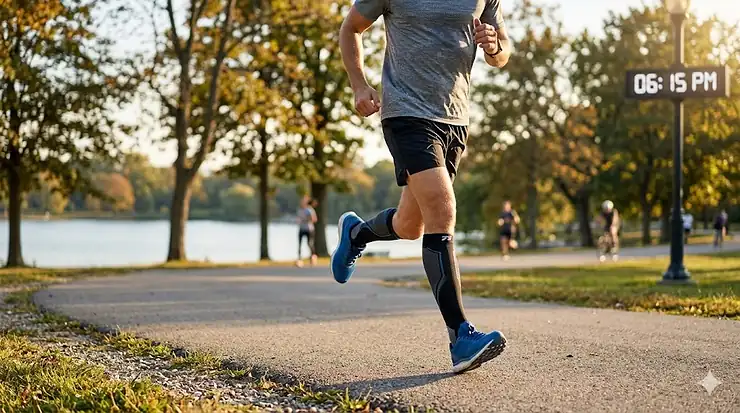
Running socks for men are the most overlooked piece of performance gear in most runners’ kits. The right pair manages moisture aggressively, reduces friction before it becomes a blister, cushions impact at every footstrike, and holds its shape mile after mile. The wrong pair does none of these things — and costs you pain, training days, and motivation.
What makes a sock genuinely good for running isn’t just marketing language like “moisture-wicking” or “anti-blister.” It’s the combination of fiber science, cushion placement, seam construction, and fit architecture working together. Research published on PubMed confirms that the key strategies for preventing exercise blisters include limiting shear cycles, managing moisture at the skin surface, and eliminating pressure points — and each of those is a direct function of sock design.
For this guide, I researched and compared 7 real products currently available on Amazon — digging into materials, real customer feedback, and practical performance differences to tell you not just what the specs mean on paper, but what they mean for your feet on the road, trail, or treadmill.
Whether you’re lacing up for a 5K or building toward your first marathon, this is the guide your feet have been waiting for.
Quick Comparison: Top 7 Running Socks for Men at a Glance
| Product | Height | Material | Cushion | Price Range | Best For |
|---|---|---|---|---|---|
| Balega Hidden Comfort | No-Show | Drynamix Polyester | High | $17–$20/pair | Long-distance, cushion seekers |
| Darn Tough Run No Show Tab | No-Show | 40% Merino / 55% Nylon | None/Light | $18–$22/pair | Durability, all-weather |
| Feetures Elite Max Cushion | No-Show | ~90% Nylon / Spandex | Max | $17–$19/pair | Performance & arch compression |
| Smartwool Run Targeted Cushion | Low Ankle | Merino Wool blend | Targeted | $18–$22/pair | Odor control, daily training |
| Injinji Run 2.0 Lightweight | No-Show | Nylon / Mesh | Ultra-Light | $15–$18/pair | Blister-prone runners |
| Saucony RunDry No-Show | No-Show | Polyester blend | Light | ~$4–$7/pair (multi-pack) | Budget value |
| Swiftwick Aspire Zero Tab | No-Show | 79% Nylon / 17% Olefin | None | $14–$17/pair | Minimalist, snug race shoes |
Looking at this comparison, price doesn’t always predict performance. The Saucony RunDry wins on value when bought in multi-packs, while Darn Tough justifies its premium through longevity — that lifetime guarantee effectively means you stop buying socks. For most road runners training 3–5 days a week, the Feetures and Balega options represent the clearest sweet spot between cost and performance.
💬 Just one click — help others make better buying decisions too! 😊
Top 7 Running Socks for Men: Expert Analysis
1. Balega Hidden Comfort No-Show Running Socks
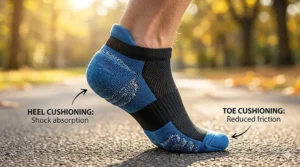
The Balega Hidden Comfort is the cushion benchmark for performance running socks, and it earns that reputation honestly. Built on a 200-needle-count fabric with proprietary Drynamix moisture-wicking fibers, it delivers dense, plush cushioning that doesn’t flatten under prolonged impact — a distinction that cheaper “cushioned” socks cannot claim past mile 10.
What most buyers overlook about this sock is the engineering behind the deep heel pocket. Generic no-show socks creep into the shoe during a run, bunching behind the Achilles and creating a friction ridge. The Balega’s reinforced heel pocket and high tab physically prevent this, keeping the sock locked in position whether you’re at mile 1 or mile 20. Those microfiber mesh ventilation panels aren’t cosmetic — they actively expel heat from the ball of the foot, where heat buildup creates the friction that leads to blisters.
This is the sock I’d hand first to any runner attempting their first half marathon, or any runner who’s ever abandoned a long run because of heel blisters. The hand-linked seamless toe box removes the stitched ridge that standard socks press into the top of your toes on longer efforts — a detail that sounds minor until you’re 15 miles in.
Customers consistently report 6+ months of solid performance with regular washing. A handful note it runs warm in summer heat.
✅ 200-needle plush cushioning, race-tested
✅ Deep heel pocket + high tab prevents slipping
✅ Hand-linked seamless toe, no friction ridge
❌ Can feel warm during hot-weather runs
❌ Premium per-pair price
Price range: around $17–$20 per pair. A smart investment for long-distance runners.
2. Darn Tough Vermont Men’s Run No Show Tab Ultra-Lightweight
Darn Tough has a cult following in the running community, and this no-show tab model is the reason why. Made in Vermont from 40% Merino Wool, 55% Nylon, and 5% Lycra Spandex, it leverages Merino’s natural temperature-regulating properties — actively cooling in summer, insulating in winter — without the synthetic help other brands need.
The “ultra-lightweight” label here is paired with dense, high-stitch-count construction that delivers more durability than its minimal profile suggests. Where budget thin socks develop holes after 60 washes, the Darn Tough tight-knit construction holds up long past that point. The high-density knit means more stitches per inch, translating to a sock that fits and performs like a second skin instead of a flimsy liner.
The unconditional lifetime guarantee is the genuine deal: if these socks wear out, Darn Tough replaces them free. For a runner going through 300+ miles of training per year, that effectively makes this a lifetime sock purchase.
Best for runners with heat-sensitive feet who want minimal bulk, or anyone training year-round in varied conditions. Trail runners in low-profile shoes benefit from the True Seamless toe and all-weather Merino performance.
Customers regularly praise the “barely there” feel and standout durability compared to similarly priced alternatives.
✅ Merino Wool: all-weather, natural temperature regulation
✅ Unconditional lifetime guarantee (made in USA)
✅ Ultra-lightweight without sacrificing durability
❌ No cushion — not suitable for cushion-seekers
❌ Higher upfront cost than synthetics
Price range: $18–$22 per pair. Quite literally the last running sock you’ll have to repurchase.
3. Feetures Elite Max Cushion No-Show Tab
Named “Best Running Sock Overall” across multiple 2026 expert roundups, the Feetures Elite Max Cushion earns that title through a feature that sounds like marketing but genuinely changes the running experience: anatomical left/right construction. Each sock is engineered for a specific foot, conforming to the natural curve and arch distribution that a generic sock simply ignores. Once you run in anatomical socks, going back to symmetrical pairs feels like removing insoles.
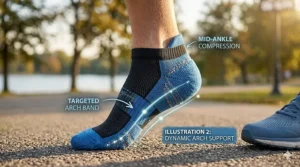
The targeted compression is the defining spec here. Zone-specific pressure wraps the arch without constricting circulation, reducing foot fatigue on longer efforts in a measurable way. The approximately 90% nylon construction wicks aggressively — runners report noticeably drier feet than most alternatives on intervals and tempo runs. Max Cushion padding at heel and toe handles repetitive impact absorption that causes late-race plantar fatigue.
This is the sock elite runners reach for on race day and serious recreational runners rely on through high-mileage training cycles. For anyone experiencing arch fatigue or plantar fasciitis flare-ups, the targeted compression element adds meaningful structural support.
Amazon reviewers highlight consistent sizing accuracy and impressive odor resistance after multiple training sessions.
✅ Anatomical left/right design — genuinely custom fit
✅ Targeted arch compression reduces fatigue
✅ Max cushion absorbs repetitive heel and toe impact
❌ Single-pair price is steep
❌ Lighter build shows wear faster than Darn Tough over 600+ miles
Price range: around $17–$19 per pair. The smart investment for serious training schedules.
4. Smartwool Men’s Run Targeted Cushion Low Ankle Socks
Smartwool knows Merino wool, and this Run Targeted Cushion model demonstrates that knowledge through placement intelligence: light terry cushioning precisely at the toe and heel, and nothing extra through the midfoot where unnecessary padding creates heat and restricts natural foot flex. That’s the kind of design decision a brand makes after thousands of hours of field testing, not just stuffing material into every zone.
What the spec sheet won’t tell you is how dramatically different Merino smells after a sweaty summer run compared to synthetic alternatives. Wool’s natural antimicrobial properties suppress bacterial growth at the fiber level — no chemical treatment required, no “wash out” after 30 cycles. For runners who train daily and can’t always wash socks between sessions, this is a meaningful real-world advantage. Smartwool’s Indestructawool technology also reinforces the highest-wear zones, extending the lifespan of the Merino construction beyond what untreated wool could sustain.
Low ankle height threads the needle between no-show (which risks Achilles chafing) and quarter-crew (which some runners find too visible). It’s the height for daily training shoes and casual wear alike.
Ideal for daily trainers, commuter runners, and anyone who runs in the morning and heads straight to work.
✅ Merino wool: lasting natural odor resistance
✅ Targeted (not uniform) cushioning — smart placement
✅ All-weather temperature regulation built-in
❌ Wool requires gentle-cycle washing
❌ Slightly warmer feel in peak summer heat
Price range: $18–$22 per pair. The best daily training sock on this list.
5. Injinji Run 2.0 Lightweight No-Show Toesocks
Toe socks look odd. First-time users feel strange putting them on. But here’s what the spec sheet won’t tell you: the leading cause of inter-toe blisters isn’t shoe friction — it’s skin rubbing against skin. When each toe is individually wrapped in fabric, that friction source disappears completely.
Injinji’s patented five-toe design uses 200-needle-count construction for ultra-thin walls between toes — not bulky cotton separators, but nearly invisible individual toe sleeves. Mesh panels across the top of the foot maximize airflow. The no-show heel tab keeps the sock anchored without creeping. Published research on PubMed supports the logic: a double-blind study on sock fiber and blister frequency found that reducing skin-to-skin shear is among the most reliable prevention strategies, and toe socks directly target this mechanism.
For runners with wide feet, Morton’s toe, or a history of blisters on anything over 8 miles, the Injinji is genuinely transformative rather than gimmicky. Experienced ultra-runners frequently cite toe socks as the single gear change that resolved recurring foot problems.
Customers who switched from standard socks after chronic blister issues consistently describe the result as a “game-changer.”
✅ Eliminates toe-to-toe friction at the source
✅ Ultra-thin 200-needle-count construction
✅ Mesh top for maximum ventilation
❌ Learning curve for first-time toe sock users
❌ Not ideal for very narrow feet
Price range: around $15–$18 per pair. Genuinely transformative for blister-prone runners.
6. Saucony Men’s RunDry Mesh Ventilating Performance No-Show Socks
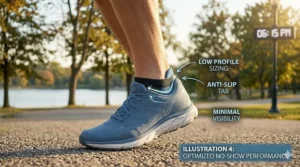
If your sock budget is tight but your mileage goals aren’t, the Saucony RunDry multi-pack is the smartest purchase on this list in terms of pure value. Available in 6-, 12-, and 18-pair bundles, these bring the effective price per pair down to roughly $4–$7 — low enough that replacing worn socks before they cause problems stops being a financial calculation.
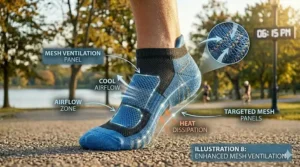
The RunDry mesh construction uses large air channels across the top of the foot for active ventilation, while targeted arch compression keeps the midfoot from sagging or bunching through longer efforts. Light cushioning at the ball and heel provides adequate impact absorption for moderate daily runs without adding unnecessary bulk inside the shoe.
The honest trade-offs versus premium options: no anatomical left/right fit, no lifetime guarantee, and no Merino performance in cold weather. What you’re getting is a solid, dependable daily training sock that does its job without demanding a premium price. For runners building their mileage base, newer runners outfitting their first training cycle, or anyone who wants a large rotation without the investment, the Saucony RunDry multi-pack delivers exceptional per-mile value.
✅ Outstanding price-per-pair in multi-packs
✅ Mesh ventilation and targeted arch compression
✅ Reliable performance for daily training distances
❌ No anatomical fit or lifetime guarantee
❌ Shorter lifespan than premium Merino options under heavy mileage
Price range: approximately $4–$7 per pair in multi-pack format. The undisputed best budget pick.
7. Swiftwick Aspire Zero Tab Ultra Thin
The Swiftwick Aspire Zero is engineered for runners who believe the best sock is the one you forget you’re wearing. At 79% nylon and 17% olefin — a fiber that actively repels moisture at the yarn level rather than simply wicking it — these socks push sweat outward faster than almost any alternative on this list. There’s zero cushioning by design, which sounds aggressive until you understand the runners it’s built for.
Minimalist runners, racers in snug performance shoes, and experienced athletes who find standard socks feel bulky and restrictive are the natural audience here. The olefin content is the technical differentiator: while polyester and nylon wick moisture away, olefin repels it, meaning these socks stay noticeably lighter and drier on hot days when every gram of absorbed sweat works against you.
This is not the right sock for beginners or runners with plantar pain. It’s the right sock for a runner who knows exactly what they want: direct shoe contact, rapid drying, and nothing standing between the foot and the road.
According to Men’s Journal’s 2026 running gear roundup at mensjournal.com, the Aspire Zero rates as a top minimalist pick for road and track running specifically.
✅ Ultra-thin, zero-bulk design — truly disappears in the shoe
✅ Olefin fiber: rapid moisture expulsion, not just wicking
✅ Ideal for snug race shoes and minimalist running
❌ No cushioning — unsuitable for high-impact or trail running
❌ Not recommended for runners new to minimalist footwear
Price range: around $14–$17 per pair. Elite minimalist performance for experienced runners.
✨ Don’t Miss These Exclusive Deals!
🔍 Take your running game to the next level with these expert-selected socks. Click any highlighted product name to check current pricing and availability on Amazon. The right pair of running socks for men can mean the difference between a breakthrough run and a blister-filled slog.
What to Expect: Real-World Running Performance vs. What the Label Says
Specs on packaging tell you fiber percentages and feature names. Here’s what those specs actually feel like at miles 5, 10, and 20.
“Moisture-wicking” on a cheap polyester sock means the sock moves moisture to its outer layer and sits there, growing heavy and clammy. On a Feetures or Swiftwick Aspire, it means the sock actively expels moisture quickly enough that your foot stays in the dry zone throughout a full-length training run. The difference is palpable by mile 7.
“Arch compression” as a label appears on $5 multi-packs and $20 performance socks alike. What it means in practice varies enormously. The Feetures Elite targeted compression reduces fatigue-driven arch drop on longer efforts — the kind that leads to plantar soreness the next morning. Generic arch bands in budget socks provide mild bunching prevention at best.
“Seamless toe” — This is where cheap running socks fool buyers most. A fused seamless toe (as in Darn Tough’s True Seamless construction) creates genuinely zero ridge sensation. A “seamless” label on a standard sock often means a flatter-than-usual stitched seam that still raises enough of a ridge to cause irritation on runs over 10 miles.
The bottom line: trust the brand’s engineering reputation more than individual feature claims. The brands on this list — Balega, Darn Tough, Feetures, Smartwool, Injinji, Saucony, Swiftwick — have earned their reputations through consistent field performance, not just packaging.
How to Get the Most Out of Your Running Socks (Practical Usage Guide)
Buying well is step one. Using and caring for your socks correctly extends that investment significantly.
Before your first run: Wash new technical socks once before wearing. Manufacturing residues can affect wicking performance and initial fit. Merino wool socks in particular benefit from one wash to settle into their final shape.
During the run: If you feel a hot spot forming anywhere on your foot, take 30 seconds to check the fit. A bunched sock at the ball of the foot is a blister forming in real time. Stop it early.
Washing: Wash inside out in cold water on a gentle cycle. Avoid fabric softeners — they clog wicking fibers with a waxy film that degrades performance over time. Air dry when possible; tumble dry on low maximum. Hot cycles are the leading cause of premature performance sock failure. Merino wool is especially vulnerable to heat damage.
Rotation: The American Podiatric Medical Association recommends fitting running shoes with the socks you plan to train in. Rotating between 3–4 pairs ensures each pair dries completely between runs — important because bacteria that cause both odor and fiber degradation thrive in residual moisture.
Common mistakes to avoid in your first 30 days with new performance socks:
- 🚫 Wearing “just one more time” after you notice heel thinning — replace early, before the blister forms
- 🚫 Washing all socks together on a mixed hot/cold load — ruinous for Merino blends
- 🚫 Wearing the same pair back-to-back without drying — accelerates fiber breakdown
Which Running Sock Suits Your Runner Profile?
Different runners need different socks. Here’s how to match your situation to the right pick from this list.
The Mileage Builder (20–40 miles/week, road running) You need durability and moisture management above all. Best picks: Darn Tough Run No Show Tab (lifetime guarantee, Merino all-weather) or Feetures Elite Max Cushion (targeted compression handles volume). Rotate 3–4 pairs per training cycle.
The Blister-Prone Runner If you’ve had inter-toe blisters or persistent heel rubs on runs over 8 miles, your current sock design is not solving the problem. Best pick: Injinji Run 2.0 Lightweight for inter-toe relief; pair with Balega Hidden Comfort if you also need heel cushion.
The Casual 5K Runner (2–3 runs/week, under 6 miles) You don’t need to spend $20 per pair on every training day. Best strategy: Saucony RunDry multi-pack for daily runs, one pair of Feetures or Balega reserved for race day. Budget roughly $40–$50 total for a full season’s supply.
The Trail Runner Slightly more coverage and debris resistance matter. Best pick: Darn Tough No Show Tab (the tab keeps small trail debris out of the shoe) or step up to a quarter-crew height variant. Merino wool is especially valuable here for temperature regulation across varied terrain.
The Minimalist / Race-Day Runner You want direct shoe feel and nothing else. Best pick: Swiftwick Aspire Zero Tab — it performs inside snug race shoes where no other sock fits cleanly without creating volume issues.
How to Choose Running Socks for Men: 5 Key Criteria
Choosing running socks for men comes down to five factors, roughly in priority order.
- Material — Merino wool provides natural temperature regulation and odor resistance. Synthetic fibers (nylon, polyester, olefin) dry faster and cost less. For hot-weather running only, go synthetic. For year-round or all-condition training, Merino justifies its premium.
- Cushion level — More cushion means impact protection and comfort on hard surfaces; less cushion means better shoe feel and less heat buildup. Road runners doing moderate distances benefit from light-to-medium cushioning. Minimalist and race runners should look at zero or ultra-light options.
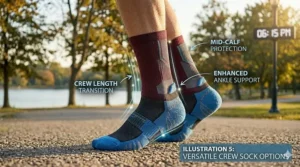
- Height — No-show tab styles protect the Achilles better than hidden no-shows that slip down. Quarter-crew is the optimal height for trail running. Crew height serves cold-weather road running.
- Fit and compression — Prioritize zoned arch compression and a deep heel pocket. Anatomical left/right socks (Feetures) offer the best performance fit, especially under high mileage.
- Seam construction — Hand-linked or fused seamless toe boxes eliminate the most common source of sock-related blisters. This is non-negotiable for any run over 10 miles.
Common Mistakes When Buying Running Socks for Men
Even experienced runners fall into these traps regularly.
Choosing by price alone. A cheap 10-pack is not a deal if you’re replacing it every 6 weeks, developing blisters, and skipping runs because your feet hurt. A $20 pair that lasts 18 months consistently beats a $5 pair that lasts 3 months — both in cost per mile and in running quality.
Ignoring cushion placement. Full-foot uniform cushioning sounds better than targeted cushioning in marketing copy. In practice, excess cushioning through the midfoot traps heat and dulls foot feel. Targeted cushioning at heel and toe (Smartwool, Feetures) protects where it counts while keeping the rest of the foot breathable.
Buying without checking shoe compatibility. A thick sock in a snug-fit shoe creates pressure points. Always verify sock thickness against your shoe’s internal volume. The experts at iRunFar recommend trying any new sock with your actual running shoes before committing.
Washing on high heat. The single most preventable cause of performance sock death. Hot cycles destroy elastic fibers and shrink Merino blends beyond recovery. Always wash cool, dry low.
Running the same pair back-to-back. Even the best running socks need 24 hours to dry completely. Bacteria thrive in residual moisture and break down both fiber and performance. Three to four pairs in rotation is the practical minimum for serious runners.
Running Socks vs Regular Athletic Socks: A Clear-Eyed Comparison
The case for upgrading goes beyond comfort — it comes down to what happens to fabric under running-specific stress.
| Feature | Running Socks | Regular Athletic Socks |
|---|---|---|
| Moisture Wicking | Advanced fiber tech (Merino, Coolmax, Drynamix, Olefin) | Basic cotton/poly blend |
| Arch Compression | Zoned, targeted to foot anatomy | Minimal or none |
| Seam Construction | Seamless / hand-linked toe box | Standard stitched seam |
| Cushion Placement | Strategically positioned at impact zones | Uniform padding or none |
| Blister Resistance | Primary engineering goal | Not a design priority |
| Anatomical Fit | Left/right specific (premium models) | Generic shape |
| Price per Pair | $14–$22 | $2–$6 |
| Running Lifespan | 300–600+ miles | Under 100 miles |
The key insight here: regular athletic socks are designed for durability in general movement, not for the 1,000+ ground contacts per mile that running generates. Each footstrike creates shear forces between your skin and the sock — forces that cause blister formation when moisture, heat, and friction combine. Running socks are engineered specifically to interrupt that process. Regular athletic socks are not.
At a cost of roughly 4 cents per mile for a premium running sock, it’s one of the most efficient performance investments in any runner’s kit.
Running Socks for Men: Understanding Gender-Specific Fit and Sizing
Most running socks on the market are technically unisex, sized in ranges (e.g., Large = US shoe size 9–12). Men’s-specific models, however, typically accommodate wider toe boxes and offer larger sizes — some brands extend to US shoe size 15 or beyond. For the majority of male runners, the most important step is matching sock size to shoe fit, not just buying the largest available.
Why sizing matters more than most runners realize: A sock that’s too large bunches in the toe box and heel — creating exactly the friction ridges it’s supposed to eliminate. A sock that’s too small compresses the toes, restricts blood flow, and accelerates fatigue. The Feetures Elite anatomical design actually goes further, with separate left-foot and right-foot construction shaped to the natural curve differential between feet — a detail that becomes immediately noticeable on runs over 8 miles.
For most men, the practical sizing guidance is simple: if you’re on the boundary between two size ranges (e.g., shoe size 10 sits at the upper edge of a Medium and the lower edge of a Large), go with the larger size for performance running socks. The slight extra length accommodates natural foot swelling during longer runs, which typically adds 0.5–1 full shoe size worth of volume after 30–60 minutes of sustained effort.
Long-Term Cost and Maintenance of Running Socks
Let’s settle the per-pair value question with honest math. A $20 pair of Darn Tough socks with a lifetime guarantee costs $0 after the first replacement. A $7 pair replaced every 4 months costs $21 per year indefinitely. The lifetime-guarantee sock pays for itself before the end of year one.
For premium socks without a guarantee, expect 400–600 miles of peak performance from quality Merino blends. At 25 miles per week, that’s 4–6 months. Synthetic socks tend to see performance decline earlier — around 250–400 miles — but cost less per pair as a trade-off.
Maintenance tips that extend sock life:
- Wash inside out in cold water (preserves fiber structure and color vibrancy)
- Skip fabric softeners — they coat and permanently clog wicking fibers
- Air dry when possible; tumble dry on low maximum
- Store flat or loosely rolled, never forced into tight balls that stress elastic fibers
- Inspect heel and toe zones monthly — replace at first visible thinning, not when a hole appears
That last point matters more than most runners appreciate. A thinning heel isn’t just cosmetic wear — it’s a sign the protective fabric layer is gone and micro-friction has already increased. Replacing at that point costs you one pair of socks. Waiting until the hole forms costs you a blister and potentially a missed training week.
Frequently Asked Questions About Running Socks for Men
❓ What are the best men's running socks to prevent blisters?
❓ How often should men replace their running socks?
❓ Do running sock sizes differ from regular shoe sizes?
❓ Are men's sizing guides different from women's for running socks?
❓ Can I wear men's performance running socks for everyday use?
Conclusion
The best running socks for men are not a luxury purchase — they’re protective equipment. Every mile you run generates hundreds of footstrikes, and what stands between your skin and friction, heat, and impact is a few grams of carefully engineered fabric.
Get that fabric right, and you run farther, recover faster, and forget your feet exist during the miles that matter most. Get it wrong, and you’re managing blisters, adjusting your gait, and losing training days to something a $15–$20 purchase could have prevented entirely.
The seven picks in this guide each solve a specific problem for a specific type of runner. Balega for cushion-seekers. Darn Tough for durability. Feetures for elite performance. Smartwool for odor control and daily training. Injinji for blister-prone athletes. Saucony RunDry for budget-conscious runners building mileage. Swiftwick Aspire for minimalists who want nothing between foot and shoe.
If you’re just starting out, begin with the Saucony RunDry multi-pack. If you’re serious about your training, invest in a rotation of Feetures Elite or Darn Tough. If blisters have been your nemesis for years, try the Injinji before accepting that fate.
Your feet carry you everywhere. Give them the upgrade they deserve.
✨ Don’t Miss These Exclusive Deals!
🔍 Check current pricing and availability on all seven of these top-rated running socks for men directly on Amazon. Prices and stock update frequently — click through to see today’s offers and start running in the comfort you’ve been missing.
Recommended for You
- 7 Best Running Socks for Beginners That Stop Blisters (2026)
- Cushioned vs Lightweight Running Socks: 7 Best Picks 2026
- 7 Best Darn Tough vs Smartwool Hiking Socks Tested 2026
Disclaimer: This article contains affiliate links. As an Amazon Associate, I earn from qualifying purchases. If you purchase products through these links, we may earn a small commission at no additional cost to you.
✨ Found this helpful? Share it with your friends! 💬🤗
