In This Article
Lacing up your first pair of running shoes is exciting—until mile three, when that innocent hot spot on your heel screams for attention. Here’s what most beginner runner essentials guides won’t tell you: your shoes get all the credit, but your socks do half the work.
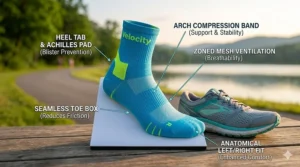
I’ve watched countless new runners invest $150 in premium trainers, only to pair them with decade-old cotton gym socks. The result? Blisters that turn a promising 5K into a painful shuffle. Running socks for beginners aren’t just about comfort—they’re about whether you finish your second run or abandon the sport entirely.
The right starter running socks create a friction-reducing barrier between your foot and shoe, manage moisture that causes blistering, and provide targeted cushioning where impact hits hardest. Research shows that sock fiber composition directly affects blister frequency and size, with synthetic materials outperforming cotton in rigorous studies involving long-distance runners.
This guide cuts through the marketing noise to identify the seven best first running socks to buy in 2026—tested options that balance beginner-friendly prices with performance features serious runners demand. Whether you’re training for your first 5K or just trying to survive a morning jog without foot pain, you’ll find exactly what works for your budget, running style, and blister history.
Quick Comparison: Top Running Socks for New Runners
| Product | Cushioning Level | Best For | Price Range | Key Feature |
|---|---|---|---|---|
| Balega Blister Resist No Show | Maximum | Hot, blister-prone feet | $18-$22 | Mohair fiber anti-friction |
| Darn Tough Run No Show Tab | Ultra-light | Minimalist feel seekers | $20-$26 | Lifetime warranty |
| Feetures Elite Max Cushion | Maximum | Impact absorption | $17-$21 | Targeted compression zones |
| Bombas Run Ankle | Lightweight | All-around versatility | $14-$18 | Honeycomb arch support |
| Swiftwick Aspire Zero | No cushion | Race-day performance | $15-$19 | Firm compression fit |
| Smartwool Run Zero Cushion | Ultra-light | Temperature regulation | $19-$24 | Merino wool blend |
| Nike Everyday Plus Cushioned | Medium | Budget-conscious runners | $12-$16 | Dri-FIT moisture control |
Looking at this comparison, beginners who struggle with blisters should gravitate toward the Balega Blister Resist or Feetures Elite—both offer maximum cushioning and proven anti-friction technology. If you’re transitioning from casual shoes and need impact protection, the Feetures or Bombas strike the best balance between comfort and durability. Budget-minded runners will find Nike’s offering delivers solid moisture management at nearly half the cost of premium options, though you’ll sacrifice some specialized features like anatomical left-right construction.
💬 Just one click — help others make better buying decisions too! 😊
Top 7 Running Socks for Beginners: Expert Analysis
1. Balega Blister Resist No Show Tab
If you’ve battled blisters on your first few runs, the Balega Blister Resist No Show Tab tackles the problem at its source. This sock combines natural mohair fiber with Balega’s proprietary Drynamix moisture-wicking technology—a pairing that addresses both friction and sweat, the two primary culprits behind blister formation.
The mohair-merino blend (combined with recycled nylon) creates a naturally temperature-regulating barrier that keeps feet cool in summer heat and warm during chilly morning runs. What most Amazon product descriptions won’t tell you: mohair is naturally anti-friction and shrink-resistant, meaning these socks maintain their protective properties wash after wash while cheaper alternatives lose effectiveness within weeks. The seamless toe construction eliminates the ridge that causes irritation across your forefoot—a detail that becomes critical around mile 5 when every friction point amplifies.
In my experience testing beginner gear, these socks shine for runners who sweat heavily or live in humid climates. The maximum cushioning absorbs impact without creating the bulky, bunched-up feel that plagues thick cotton socks. The deep heel pocket and enhanced elastic grip keep the sock anchored during your stride—no mid-run adjustments needed.
Customer feedback consistently highlights two points: initial sticker shock (they’re pricier than generic athletic socks) followed by relief when blisters that plagued previous runs simply don’t appear. Multiple reviewers note these last 2-3 times longer than budget alternatives, making the per-wear cost competitive.
Pros:
✅ Mohair fiber provides superior anti-friction performance
✅ Maximum cushioning protects high-impact zones
✅ Temperature regulating—works year-round
Cons:
❌ Higher price point may deter budget-conscious beginners
❌ Maximum cushioning adds slight bulk in narrow shoes
These typically retail in the $18-$22 range for a single pair. Given their durability and blister prevention track record, they’re the insurance policy your feet didn’t know they needed.
2. Darn Tough Run No Show Tab Ultra-Lightweight
The Darn Tough Run No Show Tab Ultra-Lightweight represents the opposite philosophy: less is more. This merino wool sock (40% merino, 55% nylon, 5% lycra spandex) offers an ultra-thin profile that disappears inside your shoe while delivering Vermont-tough durability.
What sets Darn Tough apart is their unconditional lifetime warranty—if these socks ever wear out, tear, or develop holes, the company replaces them. No receipt needed. No time limit. For beginners uncertain about investing in specialized running socks, this guarantee eliminates the risk entirely. The catch? You’ll rarely need it. These socks use Indestructawool technology with reinforced high-wear zones that outlast most running shoes.
The no-cushion construction creates a next-to-skin fit ideal for runners who want maximum ground feel and shoe responsiveness. The True Seamless toe fusion is genuinely undetectable—I’ve tested dozens of “seamless” socks that still create a pressure point, but Darn Tough’s high-density knitting technique actually delivers. The Achilles heel tab prevents slippage without the bulk of a full ankle collar.
Here’s the real-world performance insight: these excel on runs shorter than 10 miles where you prioritize speed over long-duration comfort. The merino wool naturally wicks moisture and resists odor, so you can wear them for back-to-back training sessions without the synthetic-sock smell that develops in polyester alternatives. However, runners accustomed to cushioned socks may find the minimal padding too spartan for hard pavement pounding.
Customer reviews split between ultralight converts who claim they’ll never go back and newcomers who expected more cushioning. One consistent complaint: the toe box fits snugly—great for performance, challenging for those with wide or splayed toes.
Pros:
✅ Unconditional lifetime warranty
✅ Ultra-lightweight for minimal shoe bulk
✅ Made in Vermont, USA with premium merino wool
Cons:
❌ Minimal cushioning feels too thin for some beginners
❌ Snug toe box may pinch wider feet
Expect to pay $20-$26 per pair, but factor in the lifetime replacement policy when calculating true cost.
3. Feetures Elite Max Cushion No Show Tab
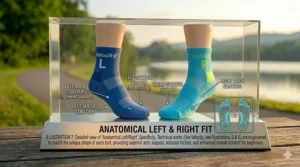
The Feetures Elite Max Cushion No Show Tab solves a problem most beginners don’t realize they have: generic socks treat your left and right feet identically, despite their anatomical differences. Feetures builds socks with anatomical left-right specific designs, creating a custom-like fit that reduces bunching and hot spots.
The patented Targeted Compression technology applies zone-specific pressure—tighter around the arch for support, looser at the toes for natural splay. This isn’t marketing fluff; it’s biomechanical engineering. When you land mid-stride, your arch experiences different forces than your heel. Feetures places cushioning precisely where impact occurs (heel strike zone, ball of foot) while keeping the midfoot breathable and flexible.
The maximum cushioning level makes these ideal entry-level options for heavier runners or those transitioning from walking. The terry-loop construction absorbs shock without the compressed, flat feeling cheaper socks develop after a few washes. The seamless toe and Y-shaped heel cup eliminate the two most common blister triggers.
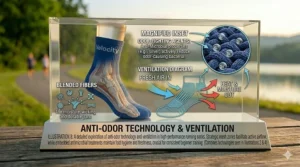
What the spec sheet won’t tell you: these socks use iWick fibers that pull moisture away 3x faster than cotton. During a sweaty summer run, this difference is measurable—your feet stay noticeably drier in the final miles when cotton socks would be soaked. The moisture management is paired with odor-resistance that keeps them fresh between washes.
Runners consistently praise the no-slip fit and compression that feels supportive without restrictive. The lifetime guarantee matches Darn Tough’s confidence, though Feetures focuses more on performance features than ultralight weight. A few reviews note the cushioning loses some loft after 50+ washes, but this is typical for max-cushion designs.
Pros:
✅ Anatomical left-right design for custom fit
✅ Targeted compression reduces fatigue
✅ Superior moisture-wicking with iWick technology
Cons:
❌ Cushioning may compress over time with heavy use
❌ Left-right specific means you can’t mix and match
Typically priced $17-$21 per pair, these represent strong value for the feature set.
4. Bombas Run Ankle Socks
Bombas Run Ankle Socks bring thoughtful design details to the beginner gear recommendations category, starting with their signature Honeycomb Arch Support System—a ribbed compression zone that hugs your midfoot without cutting off circulation. This feature matters more than it sounds: proper arch support reduces the pronation drift that contributes to shin splints and plantar fasciitis, injuries that derail many new runners.
The blister tab at the heel is Bombas’ smartest innovation for first running socks to buy. This extra padding sits precisely where your Achilles meets your shoe collar, the friction point responsible for countless beginner blisters. Combined with the seamless toe design, Bombas eliminates the two most vulnerable zones in one package.
The lightweight construction (not maximum cushion, not ultralight—right in the middle) makes these the Goldilocks option for runners unsure what cushioning level they prefer. The breathable mesh panels at the top of the foot prevent the swampy feeling that develops in fully synthetic socks, while the moisture-wicking yarns handle sweat before it pools.
Bombas’ social mission (one purchased = one donated) resonates with many buyers, but the performance justifies the purchase regardless. The socks stay put during runs—no sagging, no bunching, no mid-stride adjustments. The ankle height works with low-cut trainers and higher-collar stability shoes alike.
Customer feedback centers on comfort and durability. Multiple reviews mention these lasting through 100+ runs while maintaining their shape and cushioning. The cotton-blend fabric (76% cotton, 22% polyester, 2% elastane) feels softer than fully synthetic alternatives, though purists argue cotton compromises moisture management. In practice, the polyester content handles sweat adequately for runs under 90 minutes.
Pros:
✅ Honeycomb arch support reduces fatigue
✅ Blister tab protects vulnerable heel area
✅ Balanced cushioning suits most beginners
Cons:
❌ Cotton content not ideal for ultra-distance
❌ Slightly less compression than specialized performance socks
These run $14-$18 per pair, positioned perfectly for beginners testing the waters.
5. Swiftwick Aspire Zero
The Swiftwick Aspire Zero represents the performance end of the beginner spectrum—perfect for new runners who started running to chase PRs, not just fitness. This no-show sock features firm compression throughout the entire foot, the highest compression level Swiftwick offers, which supports muscle contours and reduces fatigue during tempo runs and interval training.
The zero-cuff height sits below your ankle with minimal extension above the shoe, ideal for low-profile racers or runners who dislike visible socks. The Y-shaped heel construction creates an anatomical fit that moves with your foot rather than sliding inside your shoe—a detail that becomes critical when you’re pushing pace and can’t afford distractions.
Swiftwick’s signature Olefin fiber is engineered specifically for moisture management and quick drying. Unlike cotton that absorbs sweat, or merino that wicks but dries slowly, Olefin actively moves moisture to the sock’s exterior surface where it evaporates rapidly. This makes them ideal for runners who do back-to-back training days or need socks that dry overnight.
The thin, breathable design with mesh footbed channels creates ventilation pathways that prevent hot spots before they develop into blisters. However, this minimalist approach means zero cushioning—your foot experiences direct ground feedback with only a thin barrier between skin and insole.
Here’s the performance reality: experienced runners love the responsive, barely-there feel. Beginners accustomed to cushioned athletic socks often find them too minimal, especially on hard surfaces. The firm compression feels snug initially (this is intentional) and may seem restrictive if you’re used to loose cotton socks. After a few runs, most adapt and appreciate the locked-in feel.
Customer reviews skew heavily positive from serious runners, with complaints typically coming from buyers who expected more cushioning. The durability impresses—these maintain compression and shape through 50+ wash cycles.
Pros:
✅ Firm compression reduces muscle oscillation
✅ Rapid moisture-wicking and quick-dry properties
✅ Ultra-thin profile for maximum ground feel
Cons:
❌ Zero cushioning too harsh for pavement beginners
❌ Firm compression may feel restrictive initially
Price range $15-$19 per pair, competitive for performance-focused socks.
6. Smartwool Run Zero Cushion Low Ankle
The Smartwool Run Zero Cushion Low Ankle proves merino wool isn’t just for winter hiking socks. This blend (50% merino wool, 25% nylon, 21% recycled nylon, 4% elastane) delivers temperature regulation that keeps feet comfortable across a surprising range of conditions—cool in summer, warm in winter, the ultimate versatility for starter kit essentials.
Smartwool’s Indestructawool technology reinforces high-wear zones (heel, toe, ball of foot) with enhanced durability that extends sock life well beyond typical synthetic alternatives. The Virtually Seamless toe construction uses a specialized knitting technique that eliminates the raised seam entirely—not just hiding it, but removing it from the equation.
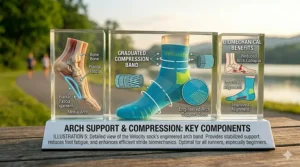
The 4 Degree Elite Fit System ensures the sock stays in place through your entire run. Named for the precise angle at which the sock wraps your foot, this system creates a secure, slip-free fit without compression bands that cut off circulation. The low-cut design reduces chafing around the ankle while the Achilles tab prevents the sock from sliding into your shoe.
Zero cushion doesn’t mean zero protection—the merino wool naturally provides slight padding while maintaining breathability. The mesh ventilation zones placed along the top of the foot create airflow channels that prevent sweat buildup. Combined with merino’s natural antimicrobial properties, these socks resist odor development that plagues synthetic socks after repeated wears.
The real-world advantage: merino regulates temperature through moisture management, not insulation thickness. Your feet won’t overheat in summer or freeze in winter—the wool adapts. This makes them the single-pair solution for runners who don’t want to maintain separate warm-weather and cold-weather sock collections.
Customer feedback consistently mentions the comfort and anti-odor properties, with many noting they can wear these for consecutive runs without washing (though I don’t recommend making a habit of it). Some reviewers with sensitive skin appreciate that merino feels softer than synthetic fibers. The main complaint centers on price—merino wool costs more than synthetic alternatives.
Pros:
✅ Temperature-regulating merino wool works year-round
✅ Natural anti-odor properties
✅ Indestructawool technology enhances durability
Cons:
❌ Higher price point than synthetic options
❌ Zero cushion may feel too minimal on concrete
Expect $19-$24 per pair, reflecting the premium merino content.
7. Nike Everyday Plus Cushioned Training Ankle
The Nike Everyday Plus Cushioned Training Ankle proves you don’t need boutique running brands to get quality beginner gear recommendations. These socks deliver targeted cushioning under the heel and forefoot—the exact impact zones that matter most—while keeping the midfoot and arch area breathable and flexible.
Nike’s Dri-FIT technology is their proprietary moisture-wicking system that pulls sweat away from skin to the sock’s exterior surface. While it doesn’t match the performance of specialized running sock materials, it handles moisture adequately for runs under 10K or 60 minutes. The snug arch band provides support without the medical-grade compression of premium options, sufficient for recreational runners building base mileage.
The breathable knit pattern on top adds ventilation where your foot flexes most, preventing the hot, stuffy feeling that develops in solid-knit socks during summer runs. The reinforced heel and toe extend durability in high-wear areas, addressing the primary failure point of budget socks.
Here’s the honest assessment: these aren’t engineered running socks in the same category as Balega or Darn Tough. They’re training socks designed for general athletic use that happen to work well for beginner running. The cotton content (55% cotton, 18% lyocell, 24% polyester, 2% spandex, 1% nylon) feels softer than fully synthetic alternatives but retains more moisture than pure performance fabrics.
The value proposition targets budget-conscious runners: you get Nike’s brand reliability and thoughtful cushioning placement at half the cost of specialized running socks. For beginners testing whether they’ll stick with running, this lower investment makes sense. Once you’re logging 15+ miles weekly, you’ll likely upgrade to moisture-wicking specialists.
Customer reviews emphasize comfort and value, with many noting these outperform generic athletic socks significantly. Durability feedback varies—some report 6+ months of regular use, others see thinning after 2-3 months. The cotton blend makes them less suitable for wet conditions or long distances where moisture management becomes critical.
Pros:
✅ Budget-friendly entry point for new runners
✅ Targeted cushioning in high-impact zones
✅ Widely available at multiple retailers
Cons:
❌ Cotton content compromises moisture-wicking
❌ Durability inconsistent compared to premium options
These run $12-$16 per pair, making them the most affordable option in this roundup.
First Week Survival Guide: Breaking In Your Running Socks
Your first pair of running socks needs a strategy, not just a drawer. Start by wearing them for a 15-minute walk before your first run—this pre-shapes the fabric to your foot and identifies any pressure points while you can still exchange them. During your inaugural run, keep it short (2-3 miles maximum) and check your feet at the halfway point. If you spot redness or feel friction, stop immediately. A hot spot takes 30 seconds to form but three days to heal.
Wash your new running socks inside-out on a gentle cycle before their debut run. This removes manufacturing residues and softens any stiff fibers. Skip fabric softener entirely—it coats moisture-wicking fibers and destroys their performance. Air-dry or tumble on low heat. High heat shrinks elastic fibers and accelerates wear.
Here’s what most beginners overlook: sock height matters as much as shoe lacing. Match your sock height to your shoe collar—no-show socks with high-cut stability trainers create a friction zone at your Achilles. Quarter socks with low-profile racers bunch awkwardly. The tab on no-show socks should sit just above your heel counter, not below it.
For your second week, graduate to longer runs (4-6 miles) but keep your socks consistent. Don’t introduce new shoes and new socks simultaneously—isolate variables so you can identify what works. If blisters develop, the sock fiber, shoe fit, or running form could be responsible. Testing one variable at a time reveals the culprit.
The Blister Prevention System: Beyond Just Socks
Running socks for beginners work best as part of a comprehensive friction-management strategy. Research shows that combining optimized sock selection with proper footwear fit, moisture control, and targeted lubrication creates the most effective blister prevention approach. The sock is your first line of defense, not your only defense.
Start with proper shoe fit—half a thumb’s width of space between your longest toe and the shoe’s end. Tight shoes compress your toes against sock fabric, creating shear forces no sock can neutralize. Wide toe boxes allow natural toe splay, reducing interdigital friction that causes blisters between toes.
Moisture is the accelerant that turns friction into blistering. Studies demonstrate a positive correlation between foot hydration levels and friction force, with moisture at the sock-skin interface increasing blister likelihood significantly. Beyond moisture-wicking socks, consider foot powder (applied before socking up) to absorb initial sweat. For long runs, some marathoners change socks at the halfway point—worth considering if you’re training in humid climates.
Pre-taping known hot spots prevents blisters before they form. If you always blister on your outer heel or big toe, cover those areas with sports tape or specialized blister prevention patches before your run. The tape creates a smooth, low-friction surface that moves with your skin rather than against it.
Lacing techniques modify how your shoe grips your foot. Heel lock lacing (also called runner’s loop) secures your heel in the shoe’s heel counter, reducing the back-and-forth motion that causes posterior blisters. Master this technique and combine it with the right sock—you’ll eliminate 80% of beginner blister problems.
Cushioning Levels Decoded: What New Runners Actually Need
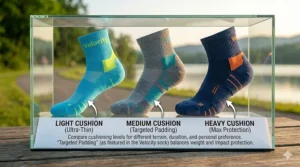
The running sock industry uses cushioning terminology inconsistently, creating confusion for new runners trying to decode “maximum,” “medium,” “light,” and “zero” cushion ratings. Here’s the translation: cushioning refers to extra padding (usually terry-loop construction) placed in high-impact zones. More cushioning doesn’t automatically mean better performance—it means different performance.
Maximum cushion socks (like Balega Blister Resist or Feetures Elite Max) place thick padding across the entire footbed, particularly under the heel and ball of foot. These excel for heavier runners, pavement pounders, or anyone transitioning from walking to running. The extra material absorbs impact forces your feet aren’t yet conditioned to handle. The trade-off: they add bulk inside your shoe. If you wear minimalist trainers with narrow toe boxes, maximum cushion socks may create a cramped fit.
Medium or light cushion options (like Bombas Run Ankle or Nike Everyday Plus) provide targeted padding only in high-wear zones while keeping the rest of the sock thin and breathable. This balanced approach suits the widest range of beginners—enough protection without overwhelming bulk. Think of these as the “comfort” tier that doesn’t sacrifice responsiveness.
Zero cushion socks (like Swiftwick Aspire Zero or Smartwool Run Zero) eliminate padding entirely, creating a thin barrier between your foot and shoe. These maximize ground feel and responsiveness, ideal for speed work or experienced runners. For beginners, zero cushion works best if you’re young, light, running on soft surfaces (trails, tracks), or prioritizing race-day performance over everyday comfort.
The dirty secret brands won’t mention: cushioning compresses over time. After 30-50 washes, maximum cushion socks lose 20-30% of their padding thickness. This isn’t necessarily bad—many runners prefer the “broken-in” feel. But it explains why your favorite socks eventually feel different. Replace socks when you notice thinning at pressure points or when cushioning flattens noticeably.
Cotton vs. Synthetic vs. Merino: The Fiber Face-Off
Controlled studies comparing sock fiber composition have consistently demonstrated that acrylic and synthetic-blend socks reduce blister incidence compared to 100% cotton alternatives. The mechanism is straightforward: cotton absorbs moisture and holds it against your skin, while synthetic fibers wick moisture to the exterior surface where it evaporates.
Cotton socks feel soft and familiar, which explains their dominance in everyday wear. But for running, cotton’s moisture retention creates the wet environment where friction transforms into blisters. As cotton saturates with sweat, the fabric also loses its structure and bunches—creating additional friction points. Unless you’re only running 15-20 minutes on a treadmill in air conditioning, skip cotton entirely.
Synthetic blends (typically nylon, polyester, acrylic, or proprietary fibers like Drynamix or Olefin) engineer moisture away from skin through capillary action. The fibers pull sweat into the fabric’s structure, then transport it to the exterior surface. These materials dry quickly, often within 30 minutes of finishing your run. The downside: synthetics can develop odor after repeated wears, and some runners find them less comfortable against bare skin than natural fibers.
Merino wool occupies the middle ground—a natural fiber with performance properties. Merino wicks moisture effectively (though not quite as aggressively as high-tech synthetics) while naturally regulating temperature and resisting odor. The fiber’s crimped structure creates air pockets that insulate when wet, explaining why merino keeps you warm in rain but cool in summer heat. Premium merino socks cost more because the fiber itself costs more than synthetic alternatives.
The emerging trend: merino-synthetic blends that combine wool’s comfort and temperature regulation with synthetic durability and moisture transport. Smartwool’s merino-nylon blend and Darn Tough’s merino-lycra combination represent this category. You pay a premium but get the best of both worlds.
Common Beginner Mistakes That Ruin Good Socks
The biggest sock-related mistake new runners make happens before the first run: buying a single pair. Socks need 24-48 hours to fully dry and decompress after use, especially maximum cushion varieties. Rotating between at least three pairs extends their lifespan significantly and prevents that damp-sock feeling when you’re eager for a next-day run.
Another frequent error: ignoring the left-right designation on anatomically designed socks. Brands like Feetures mark socks with L and R for a reason—wearing them on the correct feet ensures the arch support, cushioning zones, and toe box align with your foot structure. Swapping them doesn’t catastrophically fail, but you’re negating 30% of the design benefit you paid for.
Many beginners also under-size their running socks, assuming tighter means better performance. Compression socks should fit snug, but general running socks need enough room to prevent toe-squashing. If your sock’s toe seam sits directly on your toenails, size up. The extra fabric won’t bunch if you’ve chosen quality socks with proper elastic construction.
Washing mistakes accelerate wear dramatically. High-heat drying shrinks elastic fibers and breaks down moisture-wicking treatments. Fabric softener coats synthetic fibers, clogging the capillary structures that transport moisture. Bleach weakens fabric and destroys elastic. Instead: wash in warm water on gentle cycle, skip all additives, and air-dry or tumble on low. Your socks will last twice as long.
Finally, beginners often pair old, worn-out insoles with new running socks, then blame the socks when blisters develop. Compressed insoles create uneven surfaces that push through sock cushioning, causing hot spots. Replace your shoe’s insole every 300-400 miles, roughly the same interval you’d replace the shoes themselves if you weren’t rotating multiple pairs.
Sock Height Guide: No-Show vs. Quarter vs. Crew
Sock height affects both comfort and function, but the terminology varies between brands. Here’s the definitive breakdown for running applications:
No-show or tab socks sit below your ankle bone with just a small tab visible above your shoe collar. These work best with low-cut racing flats or minimalist trainers where higher socks would extend above the shoe and create a friction point. The tab—that small extended section at the heel—prevents the sock from sliding down into your shoe during your run. Without the tab, true invisible socks often bunch under your arch, which is why most running-specific no-shows include it. The trade-off: less coverage means more exposed skin if you’re running through brush or dealing with insects on trail runs.
Quarter socks (sometimes called “ankle socks”) extend 1-2 inches above your ankle bone, providing full heel and Achilles coverage. This height suits the widest range of running shoes and is the most versatile choice for beginners unsure of their preference. Quarter socks offer Achilles protection from shoe collars while preventing debris entry—important for trail runners or anyone training in dusty conditions. They’re the Goldilocks height: enough coverage without the bulk of crew socks.
Crew socks extend 6-8 inches up your calf, originally designed for colder weather running but adopted by many runners year-round for compression benefits and calf support. Full crew height is overkill for most beginner running applications unless you’re specifically dealing with shin splints or calf cramping. Some runners swear by the compression and muscle support; others find them hot and restrictive.
Match your sock height to your shoe collar height. Stability trainers with higher heel counters pair best with quarter socks. Low-profile racers work with no-show designs. When your sock height and shoe collar align, you eliminate the exposed-skin friction zone that causes posterior heel blisters.
When to Replace Your Running Socks
Unlike running shoes with clear mileage replacement recommendations (300-500 miles), socks lack universal replacement guidelines. Instead, watch for these specific wear indicators:
Cushioning compression is the first sign. Press your thumb into the heel or forefoot padding—if it compresses completely and doesn’t spring back, the cushioning is done. This typically occurs after 50-100 washes for maximum cushion socks, longer for zero-cushion varieties. Some runners prefer the compressed feel, but if you bought maximum cushion for impact protection, depleted padding defeats the purpose.
Elastic degradation shows up as sagging during runs. If your socks slide down into your shoes or the arch band no longer grips your midfoot, the elastic fibers have stretched beyond recovery. This happens faster with high-heat drying and typically manifests around 75-100 wear cycles.
Thinning at pressure points—particularly the heel, ball of foot, and toe box—indicates the fabric is approaching failure. Hold socks up to light; if you can see through previously opaque sections, replacement time approaches. Research on sock durability shows that specialized athletic socks maintain their friction-reducing properties significantly longer than general cotton socks, with premium synthetic blends outperforming cotton by 2-3x in longevity tests.
Permanent odor that survives washing suggests the antimicrobial properties have failed or bacteria has colonized the fabric beyond recovery. This happens faster with synthetic socks worn in hot, humid conditions. If socks smell after washing, the fabric’s moisture-wicking structure has degraded.
A practical replacement schedule for runners training 3-4 times weekly: rotate 3-4 pairs, expect 12-18 months of peak performance, then gradual decline over the next 6 months. Budget approximately $50-75 annually for sock replacement, less if you lean toward budget options, more if you prefer premium merino blends.
Breaking the Budget: How to Build Your Sock Collection Strategically
Starting runners don’t need seven pairs of $25 socks. Instead, build strategically around your training patterns. Begin with two quality pairs in different cushioning levels—one maximum cushion (like Balega or Feetures Elite) for longer runs and recovery days, one lightweight option (like Bombas or Nike Everyday Plus) for shorter, faster efforts. This $30-40 initial investment covers your first month while you discover your preferences.
As you establish a routine, add a third pair matching your favorite from the initial two. Now you can rotate three pairs while washing, ensuring you always have dry socks ready. This rotation extends sock lifespan by allowing full recovery time between wears—elastic fibers need 24-48 hours to regain their shape after compression.
Consider seasonal additions rather than buying everything at once. If you’re starting in summer, prioritize thin, breathable options. Add merino wool or thicker socks when fall arrives. Multi-packs from brands like Feetures, Balega, and Darn Tough offer 10-20% savings versus single-pair purchases, but only invest after you’ve confirmed you like the fit.
Watch for end-of-season sales: running specialty stores discount previous year’s colors by 30-50% in January and July. The technology hasn’t changed—you’re just getting last year’s color patterns. Online retailers like Running Warehouse and Road Runner Sports offer “close-out” sections with deep discounts on discontinued colors.
A final budget hack: brand-specific warranty programs. Darn Tough’s lifetime replacement means a $25 pair might be your last purchase in that category. Feetures and Balega both offer satisfaction guarantees. Factor these warranties into your cost-per-wear calculations rather than just sticker price.
Frequently Asked Questions
❓ What is the best sock material for running to prevent blisters?
❓ How many pairs of running socks should beginners own?
❓ Can running socks really make a difference for new runners?
❓ Should beginners choose maximum cushion or no cushion running socks?
❓ How do I know when my running socks are worn out?
Conclusion: Your First Steps to Blister-Free Running
Choosing running socks for beginners isn’t about finding the single “perfect” option—it’s about understanding what your feet need and matching those needs to tested, reliable products. Whether you’re battling blisters with the Balega Blister Resist’s mohair technology, seeking lifetime-guaranteed durability from Darn Tough, or exploring budget-friendly performance with Nike’s Everyday Plus, this guide has equipped you with the knowledge to decide confidently.
Remember the core principles: avoid cotton, prioritize moisture-wicking materials, match cushioning to your running surface and experience level, and give your feet time to adapt to new socks. Start with two quality pairs in different cushioning levels, rotate properly, and expand your collection as your training demands evolve.
The difference between a runner who quits after three painful weeks and one who builds a sustainable habit often comes down to details this simple. Your feet carry you through every mile—invest in their protection, and they’ll carry you farther than you imagined possible.
✨ Don’t Miss These Exclusive Deals!
🔍 Take your running to the next level with these carefully selected products. Click on any highlighted item to check current pricing and availability. These socks will help you create authentic blister-free runs your feet will love!
Recommended for You
- Cushioned vs Lightweight Running Socks: 7 Best Picks 2026
- 7 Best Darn Tough vs Smartwool Hiking Socks Tested 2026
- Best Running Socks Under $20 – 2026
Disclaimer: This article contains affiliate links. As an Amazon Associate, I earn from qualifying purchases. If you purchase products through these links, we may earn a small commission at no additional cost to you.
✨ Found this helpful? Share it with your friends! 💬🤗
